How Pet Insurance Reimbursement Really Works
Two policies can quote the same 80% reimbursement and the same $500 deductible and still hand back different amounts on an identical vet bill. The difference is the order in which the insurer performs two subtractions — and it is written down, if you know which document to open.
The one thing to take away. US pet insurance pays you back after you have settled the bill yourself. What arrives is not a percentage of the invoice. It is a percentage of the expenses your policy counts as eligible, with your deductible removed either before or after that percentage is applied. Insurers disagree about the order. The order changes the money. And the version that pays you less is far from rare.
Every claim comes down to two subtractions
Whatever the brand on the policy, the arithmetic has the same two moves: take out your deductible, and take out your share of what is left — your copay, which is simply the flip side of the reimbursement percentage you picked. What no quote page tells you is which move comes first.
Embrace is one of the few insurers that explains this publicly, and its own explainer names three methods in use across the US market.
Deductible first, then copay
The deductible comes off the covered charges, and your percentage is applied to what remains. This is the method that pays you the most, and Embrace states plainly that it is the one Embrace uses.
Copay first, then deductible
Your percentage is applied to the whole covered amount, and the deductible is then taken out of that smaller figure. This pays less. It is what Pets Best documents for policies underwritten by American Pet Insurance Company, and what the worked examples on Lemonade’s and Progressive’s own pages show.
A benefit schedule
No percentage of your bill at all. A published list of diagnoses, each with a maximum the plan will pay for it, regardless of what your vet actually charged. Largely a legacy structure now, but not extinct.
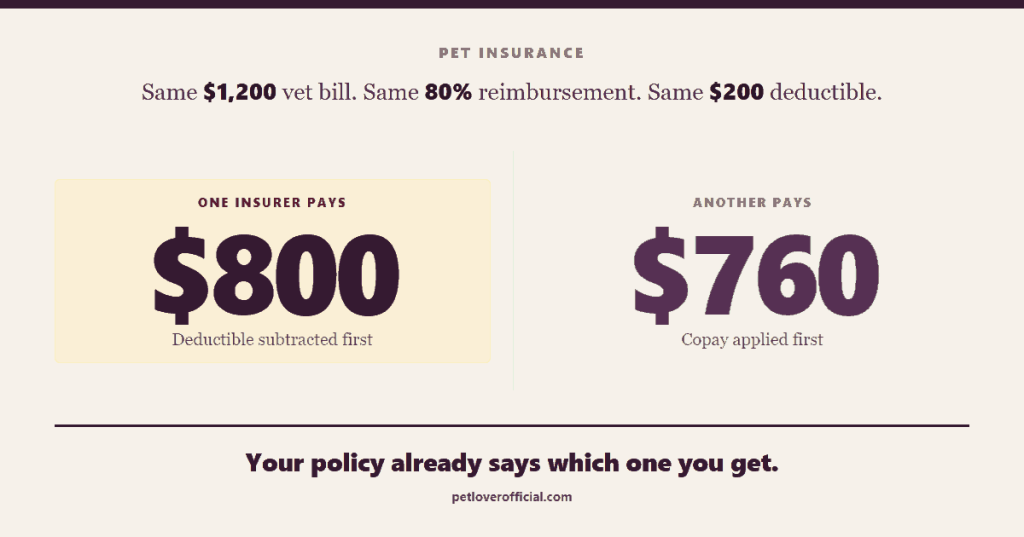
Here is the same claim run through the first two. A covered bill of $1,200, an annual deductible of $200, reimbursement at 80% — the example Embrace uses itself.
| Method | Step one | Step two | You get back |
|---|---|---|---|
| Deductible first Embrace |
$1,200 − $200 = $1,000 | $1,000 × 80% = $800 | $800 |
| Copay first Pets Best (APIC policies), Lemonade |
$1,200 × 80% = $960 | $960 − $200 = $760 | $760 |
The gap is fixed — and smaller than you are told
Embrace puts the difference between the two methods at $40 on that example, then adds: “as vet bills get costlier, that difference becomes much more.” The first half is correct. The second half is not, and it is worth understanding why, because it changes how much weight this deserves in your decision.
Write the two methods out. Deductible first gives you (bill − deductible) × rate. Copay first gives you (bill × rate) − deductible. Subtract one from the other and the bill cancels out completely. What survives is your deductible multiplied by your copay percentage — $200 × 20% = $40 — and that figure does not budge when the bill grows.
| Covered bill | Deductible first | Copay first | Difference |
|---|---|---|---|
| $1,200 | $800 | $760 | $40 |
| $5,000 | $3,840 | $3,800 | $40 |
| $20,000 | $15,840 | $15,800 | $40 |
So do not walk away from an insurer over this when what frightens you is the five-figure year. On a $20,000 surgery the order of operations is worth the same $40 it was worth on a $1,200 one, and both disappear next to the annual limit and the exclusions. Where the order genuinely bites is at the other end of the scale.
Under copay-first, a bill can clear your deductible and still pay you nothing. Take a $500 deductible at 80%. Deductible-first starts paying the moment the bill passes $500. Copay-first pays nothing until the bill reaches $625, because 80% of anything below that is smaller than the deductible waiting to be subtracted from it. Divide your deductible by your reimbursement rate to find the number your bill actually has to beat — at 70%, a $500 deductible means nothing comes back under $714.
What the percentage is a percentage of
The order of operations is worth tens of dollars. The base it operates on is worth hundreds. “80% reimbursement” means 80% of eligible expenses, and eligible expenses are not the total at the bottom of your invoice.
Usually in the base
- Diagnostics — bloodwork, imaging, biopsies
- Surgery, anesthesia and hospitalization
- Prescription medication for a covered condition
- Specialist and emergency hospital treatment
- Exam fees, but only on plans that say so
Often stripped out first
- Sales tax on the invoice
- The exam or consultation fee itself
- Anything above a “usual and customary” limit
- Anything above a benefit schedule’s cap for that diagnosis
- Waste disposal and admin line items
Exam fees are the clearest case. Trupanion states in its own FAQ that exam fees and taxes are not included in the plan, on the reasoning that they are costs you can plan for. On an emergency visit the consultation alone can run a few hundred dollars before anyone touches the animal, and on a plan that excludes it you lose twice: you pay it in full, and it does not count toward your deductible either. Progressive puts that second point explicitly — only costs that would otherwise be covered are applied to the annual deductible.
The two limits that catch people out later are quieter. A usual and customary clause lets the insurer reimburse against what it considers a normal charge for a procedure rather than the charge in front of you, which matters most in expensive metropolitan markets. A benefit schedule replaces the percentage altogether with a fixed ceiling per diagnosis: the published Major Medical schedule from VPI, the legacy brand now under Nationwide, sets a separate allowance for each diagnosis code, most of them in the hundreds to low thousands of dollars — against foreign-body surgery that routinely costs $2,000 to $10,000.
Where to lookThe document that answers this in writing
None of the above has to be guesswork, and this is the part almost nobody tells pet owners. The NAIC Pet Insurance Model Act, adopted by the NAIC in 2022 and now reflected, in varying forms, in the pet insurance laws of about twenty states (New Jersey’s law takes effect in January 2027), requires an insurer to disclose the basis or formula on which it calculates claim payments — in the policy, before the policy is issued and through a clear and conspicuous link on the main page of its website.
The act goes further. An insurer using a benefit schedule has to publish the schedule. An insurer using usual and customary limits has to include a clause describing how it determines those fees and how they are applied. And all of it has to be summarized in a separate document with a specific legal title: “Insurer Disclosure of Important Policy Provisions.” Search an insurer’s site for that phrase and you are reading the terms that decide your payout rather than the copy written to sell you the policy. Because each state wrote its own version of the law, check that your state’s version includes these requirements.
Check who underwrites your policy. Pets Best policies are underwritten by one of two companies, American Pet Insurance Company or Independence American Insurance Company, and the wording can differ between them. The formula that applies to you is the one in your own policy documents, so read those rather than a general help page.
Two protections in the same act are worth knowing before you renew. A condition your policy has covered cannot be reclassified as pre-existing when the policy renews. And waiting periods may not be applied to a renewal of existing coverage — so the orthopedic waiting period you served in year one is not restarted on you in year two.
In states whose laws follow the act, there is also a fifteen-day free look. Provided you have not filed a claim, you can return the policy within fifteen days of receiving it and have the full premium refunded within thirty days. That is the window in which to read the claim-payment disclosure — not after your first bill.
In practiceWhy the first claim is the slow one
Two separate clocks run between the vet’s counter and your bank account, and owners who expect one are the ones who call to complain. The first is adjudication: the insurer deciding what is eligible. The second is payment, which only starts once the claim is finalized.
Embrace asks for 10 to 15 business days to assess an accident or illness claim, and up to 30 days for your first one — because the first claim triggers a medical history review. That review wants detailed records from every vet your pet saw in the 12 months before your policy started, running through to the end of the illness waiting period, and Embrace says specifically that vaccination records and summaries are not enough. Then payment: 3 to 5 business days by direct deposit, or 5 to 7 business days by check in the mail.
What speeds a claim up
- Direct deposit set up before you ever claim
- The complete itemized invoice — every page, including tax and discounts
- A written diagnosis or reason for the visit, not just a total
- Your pet’s full prior records sent in at enrollment, not at claim time
What stalls one
- A summary or vaccination history in place of real records
- A vet who faxes notes late, or in pieces
- An invoice covering several pets with no breakdown
- Any first claim filed in the weeks right after enrollment
Ask your vet for the records on the day you buy the policy. Send them to the insurer straight away rather than waiting for the request. It moves the medical history review off the critical path of your first claim, and it tells you months early whether anything in the file is about to be read as pre-existing — the same argument we made for cats and for older dogs.
Three worth pricing, judged on how they pay
Embrace
Takes the deductible off first, publishes the fact that it does, and pays by direct deposit within three to five business days of settling a claim. Exam fees are an add-on, so price that in.
Get a quoteTrupanion
Pays participating hospitals during the visit, often within minutes, so you hand over your deductible and your 10% instead of the whole bill. You still pay the exam fee — it is excluded.
Get a quotePets Best
Will send the reimbursement to your vet rather than to you on every plan it sells, with a signed release form. It arrives after the claim is processed, not at checkout.
Get a quoteDirect payment to the vet is the one feature here that changes what you need in your account tonight rather than what you get back next month. Our full comparison of all six insurers covers the reimbursement rates, deductibles, annual limits and waiting periods alongside it.
QuestionsWhat owners ask about getting paid
How do I find out which order my insurer uses?
Look for the document titled “Insurer Disclosure of Important Policy Provisions”, or a footer link along the lines of “claim payment calculation”. In states whose laws follow the NAIC model act, the insurer is required to publish the basis for its claim payments there and in the policy itself. If you cannot find it, ask for it in writing before the fifteen-day free look expires.
Does the reimbursement percentage apply to the whole bill?
No. It applies to eligible expenses, which is the invoice minus anything the policy excludes — commonly sales tax, sometimes the exam fee and anything over a usual and customary limit or a benefit schedule cap. The excluded items do not count toward your deductible either, so they cost you twice.
Is it worth switching insurers over the calculation order?
On its own, no — the difference is your deductible multiplied by your copay percentage, so $40 on a $200 deductible at 80%, whether the bill is $1,200 or $20,000. Switching also resets your waiting periods and hands the new insurer a chance to call anything in the intervening records pre-existing. Weigh the order as a tiebreaker between two quotes, never as a reason to move an existing policy.
Can the insurer pay my vet instead of me?
Sometimes, and the difference between the two versions matters. Trupanion pays participating hospitals during the appointment, so you never front the covered portion. Pets Best offers direct payment on all its plans, but it goes out after the claim has been processed — useful, though it does not solve the problem of a $7,000 bill due tonight. With most other insurers, you pay in full and wait.
Why is my first claim taking so long?
Because it is not really a claim review, it is a records review. The insurer is reading your pet’s history for the 12 months before coverage began to establish what is pre-existing, and it will not settle anything until that is done. Embrace asks for up to 30 days on a first claim against 10 to 15 business days afterwards. Sending the records in at enrollment is the only way to shorten it.
Does my deductible reset every January?
It resets on your policy anniversary, not on the calendar year, unless your policy says otherwise — so an expensive December and an expensive February may fall in different deductible years, or the same one. Check the date on your declarations page before you decide whether to postpone a procedure. Trupanion is the exception: its deductible is charged once per condition for the life of the policy and does not reset at all.
Read the formula, not the percentage
The reimbursement rate on the quote page is the least interesting number in the transaction. What decides your payout is which expenses the insurer counts, where your deductible lands in the arithmetic, and how quickly the money moves once the claim is settled — and every one of those is documented somewhere you can read before you buy.
Find the claim-payment disclosure. Check whether exam fees are in or out. Set up direct deposit and send your pet’s records in on day one. Then the only number left to argue about is the premium.
Compare six pet insurersDaisuke
Daisuke writes about pet insurance and the cost of veterinary care for petloverofficial.com. He builds each comparison from insurers’ own policy documents and help pages rather than their marketing pages, cross-checks against independent reviews where an insurer does not publish a figure, and says plainly when a number is an estimate.


Leave a Reply