The Best GPS Dog Collars for Off-Leash Adventures
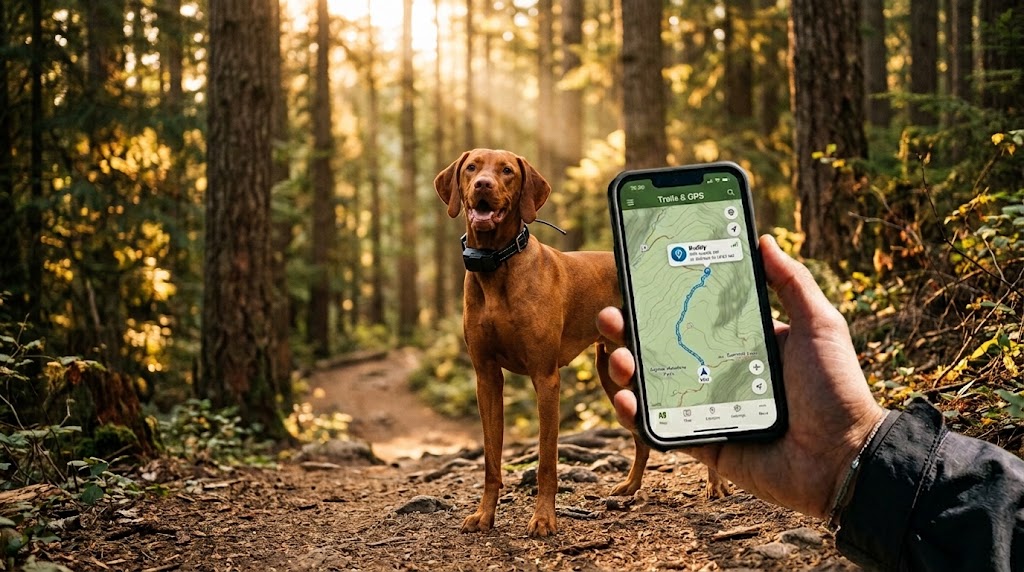
Four collars, scored on the things that actually matter when your dog disappears down a deer trail: how fast they update, how long they last, where they actually work, and what they really cost over a year.
Specs last verified: August 2026. Prices checked: September 2026. Battery ratings, subscription prices, model generations and country coverage in this category change often. Every figure below is checked against the manufacturer’s own product pages or help center, but check the current spec sheet and price before you buy.
Affiliate disclosure: This post may contain affiliate links. If you make a purchase through one of these links, we may earn a commission at no extra cost to you. No brand pays to be included or for its ranking. This comparison is built from each manufacturer’s published specifications and help center documentation, not hands-on testing, and the five-bar scores are our own assessment of those specs. How we make money.
Three picks, three different problems
Tractive GPS
Genuinely live tracking, a battery measured in weeks and a first-year cost under $200 — and on the Premium plan it keeps working if your dog travels overseas with you. The default choice for occasional off-leash trail time.
Check priceFi Series 3+
Battery measured in months, not days. Buy this if charging every few nights is what makes you give up on a collar — and if you’re tracking in the US, Canada or Mexico.
Check priceHalo Collar 5
A wireless boundary system with real training built in. It prevents the wander instead of tracking it, and it now runs its GPS continuously rather than in a low-power mode.
Check priceOff-Leash Freedom Comes With a Cost
There’s a particular kind of stomach-drop feeling that off-leash dog owners know well. You’re on a trail, or at a dog beach, or letting your dog work off some energy in an unfenced field — and then they’re gone. Not “wandered a few feet away” gone. Actually gone, out of sight, not responding to your calls.
Most of the time, they come back on their own, tongue out, thoroughly pleased with themselves. But “most of the time” isn’t good enough when the alternative is a dog loose near a road, a ravine, or a wildlife encounter neither of you wants.
My thinking about GPS collars changed because of a dog we had years ago. On one trip, my family was staying at a vacation property in the mountains that belonged to someone we knew, and the grounds felt so private and self-contained that we took his collar off and let him roam. It didn’t take him long to find a way out. Five of us spread out through the woods calling his name, and it was thirty minutes before we had him back — thirty minutes on unfamiliar ground with no idea which direction he’d gone.
That wasn’t a one-off, either. At home he was a regular escape artist. More than once we realized he was missing and found him next door, visiting the neighbors’ female dog. Another time he bolted just as we were clipping on his leash for a walk, and we spent about an hour and a half chasing him around the neighborhood. He always turned up fine, but after enough of those days I started taking GPS collars seriously, instead of thinking of them as a nice-to-have gadget. He also taught me the rule I’d put above every spec on this page: a tracker only helps if it’s still on the dog, so the collar stays on even when the setting feels safe.

If you let your dog run off-leash — on trails, at the beach, on undeveloped land, or even just in a yard without a solid fence — a GPS collar isn’t about proving you’re a bad owner for losing sight of your dog for a minute. It’s about having a fast, reliable way to close the gap between “I don’t know where my dog is” and “my dog is right there” before panic sets in.
The tricky part is that “GPS dog collar” now covers a wide range of products, from simple location trackers to full wireless containment systems with built-in training tools. They are not interchangeable, and picking the wrong one for your situation means paying for features you won’t use — or worse, not getting the one feature you actually needed.
Why not just use an AirTag? AirTags and Tiles rely on Bluetooth and crowdsourced device networks, which works fine for a wallet sitting still in one spot. A moving dog in a rural area or dense woods is a different problem — there may not be enough nearby phones to relay a signal, and there’s no live, continuously updating map view. A true GPS collar reports its own location over cellular or satellite, which is what makes real-time tracking of a moving animal actually work.
How We Judged These Collars
Before comparing specific products, it helps to have a framework that stays useful no matter which collars are on the market when you’re reading this. These are the four questions that matter most, regardless of brand or model year.
1. How does your dog actually get “loose”?
This sounds obvious, but it changes everything about which collar fits. The escape-artist dog slips out of a yard or off a leash and needs to be actively found — our own dog, above, was the textbook case. The trail-running dog is off-leash on purpose but ranges out of sight. The property-boundary dog needs a containment system more than a tracker, because the goal is preventing the wander in the first place.
A dog who needs containment is better served by a wireless-fence-style collar. A dog who’s intentionally off-leash on adventures needs fast, frequent live tracking more than fence alerts. Buying a fence-focused collar for a hiking dog, or a pure tracker for a dog who needs boundary training, is the most common mismatch in this category.
2. Does it work where you actually hike?
This is the criterion that trips up the most buyers, and it’s the one most round-ups skip entirely. Every collar here relies on a cellular network, and each brand is tied to specific carriers and specific countries.
Fi’s own help center states that the Series 3+ has tracking capability across the US, Canada and Mexico, and that Fi Series trackers run on AT&T’s network while the Fi Mini uses Verizon and the Fi Ultra uses T-Mobile. Tractive, by contrast, advertises unlimited range in 175+ countries on its Premium plan, using whichever partner network is available; its Basic plan works in one country. Within the US, all four collars work on major cellular networks — the real question is how strong that carrier’s signal is on the trails you actually use. If you travel abroad with your dog, the country list matters too.
It’s also worth checking how a collar behaves when it loses signal entirely, since trails and backcountry are exactly where cellular coverage tends to be weakest. Most fall back to showing the last known location until connectivity returns, rather than tracking blind, but how clearly that’s communicated in the app — and how quickly it catches back up — varies by brand.
3. What’s the real trade-off between battery and update speed?
Every GPS collar is balancing the same physics problem: the more frequently a device pings its location, the faster it drains its battery. A collar that updates every few seconds during live tracking will not last as long between charges as one that checks in every few minutes.
This is where headline battery numbers get misleading, and the specs bear it out. Fi advertises months of battery life — but Lost Dog Mode, the continuous-tracking mode you’d actually use during an emergency, runs down a full charge in roughly two days. FitBark publishes an unusually honest breakdown of the same trade-off: up to six months on Bluetooth alone, up to four weeks on mixed Wi-Fi and cellular with two-minute refreshes, up to ten days for a lost pet on cellular, and about six hours of continuous live tracking at a 2–3 second refresh rate.
Read every “up to” figure as the best case in the lowest-power mode, and ask what the number looks like in the mode you’d be in when your dog is actually missing.
4. What’s the full cost, including the subscription?
Virtually every GPS dog collar requires an ongoing data plan — usually monthly or annual — because tracking relies on cellular or satellite connectivity, not just Bluetooth. The collar itself is really just the hardware half of the purchase. Tractive’s Basic plan costs $108 a year and works in one country; Premium costs $120 a year, adds 175+ countries and a full year of location history, and drops to $5 a month on a five-year plan. FitBark’s plans start at $96 a year; Fi folds the tracker into a membership that costs $189 a year; and Halo’s Pack Membership starts at $9.99 a month.
Before comparing sticker prices, work out a 12-month total (hardware plus subscription) for each option. We’ve done that math for you in the cost table below.
The Collars at a Glance
| Collar | Tracking style | Battery | Where it works | First-year cost | Best for | |
|---|---|---|---|---|---|---|
| Tractive GPS DOG 6 / DOG 6 XL / XL Adventure |
Live tracking, location updates every few seconds | Up to 2 weeks (DOG 6), up to 6 weeks (DOG 6 XL), up to 4 weeks (XL Adventure)* | One country on Basic; 175+ countries on Premium | $187 (Basic) or $199 (Premium) | Hikers who want affordable live tracking, or who travel | Check price |
| FitBark GPS | Live tracking at a 2–3 sec refresh + health metrics | Up to 4 weeks in mixed Wi-Fi/cellular use; about 6 hours of continuous live tracking* | US, UK, Canada and Australia | $165.95 | Owners who want health monitoring alongside location | Check price |
| Fi Series 3+ | Periodic check-ins, Lost Dog Mode for live tracking, behavior detection | Up to 3 months in normal use; about 2 days in Lost Dog Mode* | US, Canada and Mexico | $189 | Owners who don’t want to think about charging | Check price |
| Halo Collar 5 | AlwaysOn GPS wireless fence + tracking + training | Up to 48 hours, roughly 1 hour to recharge* | US; Halo advertises coverage worldwide — confirm your country | $708.89 | Dogs who need containment and boundary training | Check price |
* Battery figures come from manufacturer specs and owner reports, and vary by model, generation, coverage, and how often live tracking is triggered. Treat them as rough starting points, not guarantees, and check the current model’s spec sheet before buying. First-year cost is hardware plus the cheapest one-year plan at US list price; the breakdown is below.
What Each Collar Costs Over a Year
Here’s the math criterion four asks you to do: the hardware plus a one-year plan, at each brand’s US list price.
| Collar | Hardware | 1-year plan | First-year total | Longer plans |
|---|---|---|---|---|
| Tractive DOG 6, Basic plan | $79 | $108 (one country, 24-hour history) | $187 | $144 for 2 years |
| Tractive DOG 6, Premium plan | $79 | $120 (175+ countries, 365-day history) | $199 | $168 for 2 years; $300 for 5 years ($5 a month) |
| FitBark GPS | $69.95 | $96 ($8 a month) | $165.95 | As low as $4 a month on a 5-year plan |
| Fi Series 3+ | Included with membership** | $189 | $189 | $339 for 2 years; $99 for 6 months |
| Halo Collar 5 | $599 | $109.89 (Bronze, billed yearly) | $708.89 | Silver $14.99 a month, Gold $19.99 a month |
Prices from each manufacturer’s US store and help center, checked September 2026, at list price before any sale — Halo and FitBark were both discounted when we checked, so your total may be lower. Both Tractive totals assume the standard DOG 6 at its $79 US list price; the larger DOG 6 XL and XL Adventure are priced separately, so add the difference if you buy one of those. Tractive’s US plans are billed yearly or longer, and LIVE tracking and virtual fences are included on both Basic and Premium. Halo’s annual billing gives you one month free; its Bronze plan allows up to 5 fences, Silver 20 and Gold unlimited. ** Fi’s current US offer has no separate hardware charge for new members; confirm any shipping or activation fee at checkout.
The takeaway: the three trackers land within about $35 of each other in year one, so choose on battery, coverage and how live tracking behaves rather than on price. Halo costs several times more because it’s doing a different job — standing in for a fence.
The Collars, Reviewed
Scores are out of five. Coverage weighs US coverage first and travel abroad second; value over 12 months is based on the cost table above.
Tractive GPS
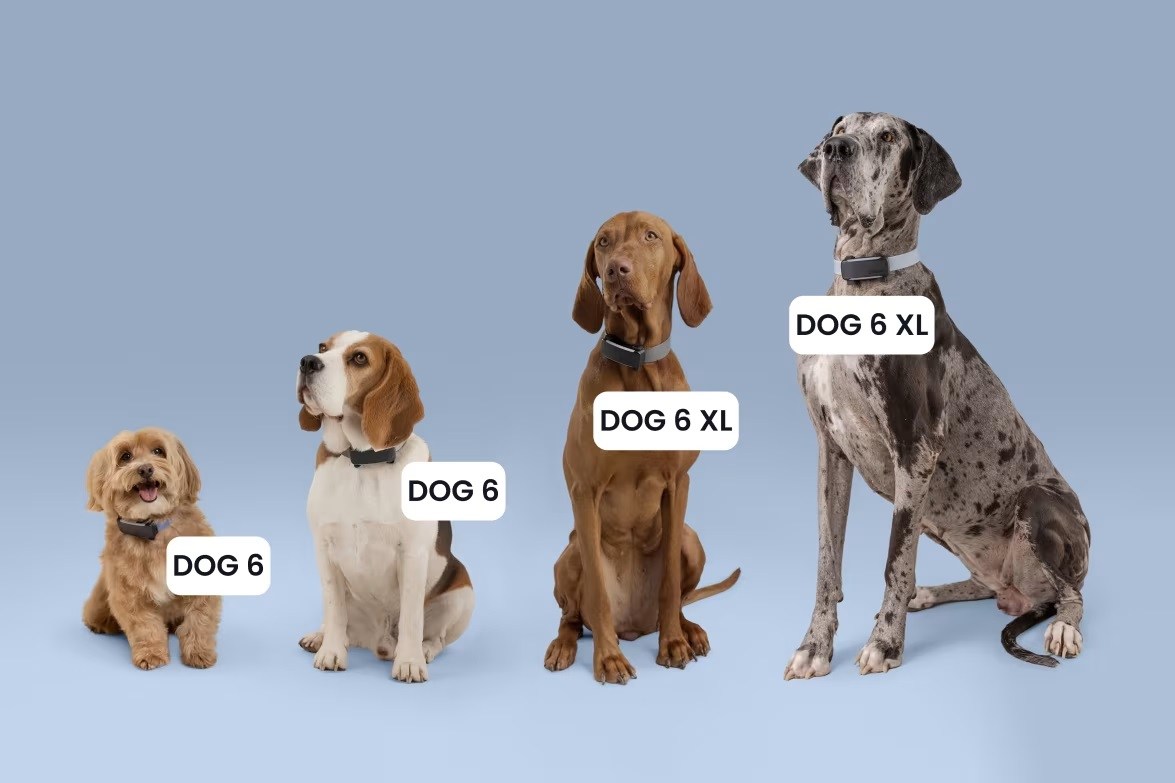
Tractive has built its reputation on straightforward, no-frills live tracking. When you open the app during an off-leash walk, you get location updates every few seconds rather than a stale “last seen” pin.
What works
- Updates frequently enough to actually follow a moving dog in real time, on either plan
- Virtual safe zones alert you the instant your dog crosses a boundary, and no-go zones work the other way around — also included on both plans
- On the Premium plan, works in 175+ countries with unlimited range — the only collar here you can take abroad and keep using
- Small, lightweight clip-on fits most existing collars
- $187 for the first year with the $79 DOG 6 on the Basic plan, or $199 on Premium — about the same as Fi and FitBark, but with live tracking that lasts far longer on a charge than FitBark’s
What to watch
- The Basic plan keeps only 24 hours of location history and works in one country. Premium ($120 a year) adds 365-day history, 175+ countries, family sharing and GPX/KML export — and in the US it isn’t offered month to month
- Constant live tracking drains the battery noticeably faster than standby
- Battery varies a lot across the lineup: Tractive rates the DOG 6 at up to 2 weeks, the DOG 6 XL at up to 6 weeks and the XL Adventure at up to 4 weeks — so pick the model, not the brand
- The bigger-battery models are sized for larger dogs (the DOG 6 XL is recommended from about 44 lbs, the XL Adventure from about 55 lbs), so small-dog owners get the shortest battery in the range
- Tracking doesn’t function at all without an active subscription
- As a clip-on, it can shift position on very active or thick-coated dogs
Where it fits: If your priority is affordable, genuinely live tracking for occasional off-leash trail time — or your dog travels abroad with you, on the Premium plan — Tractive is usually the first collar people land on, and for good reason.
FitBark GPS
FitBark’s original product was a health and activity tracker, and GPS was layered on afterward. That heritage still shows: this is the collar for owners who care as much about their dog’s wellbeing as their whereabouts.

What works
- Health scores and activity data detailed enough to be genuinely useful, especially for older dogs
- Reports are worth bringing up at vet visits
- At 16 grams (about 0.6 oz) it’s one of the lightest trackers on the market, which matters on small dogs
- Live tracking refreshes every 2–3 seconds — as fast as anything else here, contrary to its reputation as a health-first device
- The lowest first-year cost here, at $165.95 with a one-year plan
What to watch
- The speed comes at a cost: FitBark rates continuous live tracking at about 6 hours, versus up to 4 weeks in normal mixed Wi-Fi and cellular use. Live mode is a sprint, not a default setting
- Outside the US it’s sold only in the UK, Canada and Australia, so check before you travel with it
- The deepest health features sit behind a subscription
- Health data is only as useful as your willingness to actually review it
Where it fits: FitBark makes the most sense for owners who want one device covering both “where is my dog” and “how is my dog doing,” rather than two separate products.
Fi Series 3+
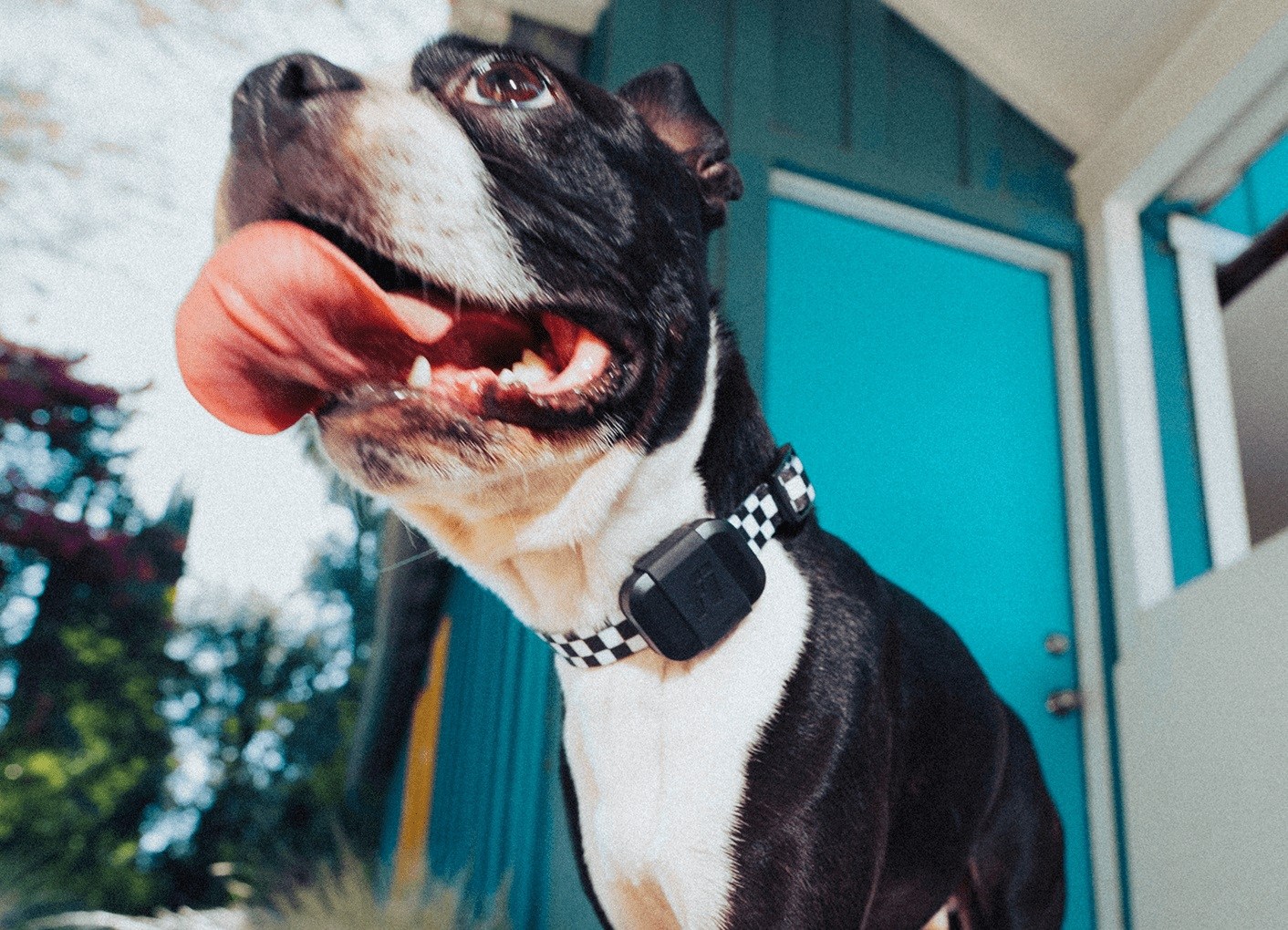
Fi’s standout claim is battery life measured in months rather than days, which sounds almost too good to be true until you understand how it gets there: the Series 3+ isn’t live-tracking all day. It checks in periodically, leans on Wi-Fi and Bluetooth when your dog is home or next to you, and saves the continuous updates for Lost Dog Mode.
What works
- Battery life is dramatically longer than nearly every other collar in this category — Fi rates the Series 3+ at 3+ months
- Behavior detection tracks patterns like scratching, licking, drinking, and barking, not just steps
- Lost Dog Mode switches to rapid live updates exactly when you need them
- Wireless charging base doubles as a home hub
- Durable, tug-resistant, waterproof design built for active dogs
What to watch
- Coverage is regional. Fi’s help center lists Series 3+ tracking capability across the US, Canada and Mexico, running on AT&T’s LTE-M network. Outside those countries, live tracking and escape alerts won’t work
- The membership is the whole cost — $189 a year, $339 for two years or $99 for six months, with a six-month minimum — and it renews automatically unless you cancel
- The multi-month battery figure and the emergency you’d actually use it in are two different modes — Lost Dog Mode runs a full charge down in roughly two days
- Sizing runs across several collar bands, so fit takes more care at setup
Fi now sells three trackers, not one. Worth knowing before you order: the Fi Mini is the lightweight option for puppies, small dogs and cats (Verizon network); the Series 3+ is the all-round adventure collar described above; and the Fi Ultra is a newer flagship that adds T-Mobile coverage plus satellite connectivity via T-Satellite with Starlink, dual-band always-on GPS, and Fi Callback, a sound-and-vibration recall system with no static. The Ultra trades battery for that capability — multiple days rather than multiple months — and it’s US-only, with no coverage in Alaska. Fi is also explicit that the Ultra is designed for off-leash use, not off-grid use: in areas with no service, the app may not be able to reach the device in real time. If you hike genuinely beyond cell coverage in the US, it’s the one to look at; for everyone else, the Series 3+ is still the better-balanced buy.
Where it fits: For owners who want to set a collar up once and not think about charging it every few days — and who track within the US, Canada or Mexico — Fi’s battery life is a genuine differentiator.
Halo Collar 5
Halo is a different category of product from the others. Rather than being primarily a tracker you check when your dog goes missing, it’s a wireless containment system designed to prevent the wander from happening in the first place, paired with a built-in training program.

What works
- A true wireless fence using GPS rather than buried wires, so boundaries work anywhere you can draw them
- Halo Collar 5 keeps its GPS running continuously — the company calls it AlwaysOn — rather than dropping into a low-power mode between checks, and analyzes location 20 times per second so a sprinting dog gets feedback approaching the boundary rather than after crossing it
- Up to 5 fences on the entry-level Bronze plan, 20 on Silver and unlimited on Gold — useful for dogs who need boundaries at more than one location
- Battery is now rated up to 48 hours, with a roughly one-hour full recharge — a meaningful change from the 30+ hours of the Halo 4 and around 20 on the Halo 3
- Dual-frequency GPS, introduced on the Halo 4, combines the L1 and L5 bands and holds up better under tree cover or near buildings than single-frequency systems
- Built-in training program with tone and vibration feedback, and configurable static as an option
What to watch
- Even at 48 hours, charging is a routine rather than an afterthought — this is a collar you plug in every night or two
- Still bulkier than a clip-on tracker, though far less so than it used to be: the Halo 4 redesign made the collar 33% smaller and 18% lighter, fits necks from 8 to 30.5 inches, and is rated for dogs from 10 lbs and 5 months old. The old “too big for small dogs” objection no longer really holds
- Subscription required — Pack Membership plans run $9.99, $14.99 or $19.99 a month depending on how many fences you need — and without one you can’t create, edit or use fences at all
- The training and static-feedback features make it a poor fit if you only want passive tracking
- $599 list for the collar, by far the highest upfront cost here
Where it fits: Halo makes the most sense for dogs who need active boundary training and containment — not just for owners who want to check a map during a hike.
Which One Fits Your Dog
Tractive is our default pick for most owners, but the right collar depends on how your dog actually gets loose. Here’s how the four sort by situation.
You hike off-leash and want reliable live tracking, not a training system
Tractive is the most straightforward starting point, with Fi as the alternative if you’d rather charge every few months than every week or two — assuming you’re in the US, Canada or Mexico.
You travel abroad with your dog
Tractive on its Premium plan is the clear answer. It’s the only collar here that advertises coverage in 175+ countries. Fi’s Series 3+ tracking stops at the US, Canada and Mexico, and FitBark covers only a handful of countries.
You hike somewhere with genuinely no cell service, in the US
This is the one case where the Fi Ultra’s satellite link is worth the shorter battery — with the caveat that Fi calls it an off-leash tool, not an off-grid one.
Your dog has health concerns you’re already monitoring
FitBark‘s combination of location and health data does double duty that a pure tracker can’t, and gives you something concrete to bring to a vet visit.
You’re managing multiple dogs
Tractive’s app includes a leaderboard that compares your pet’s activity against other pets. FitBark, Fi and Halo all support multiple collars per account, but we haven’t tested how well each interface scales across two or three dogs — worth a demo or short trial first if this is a priority.
Your dog needs boundary training, or you have no physical fence
Halo is worth the higher price and the frequent charging, because it solves a different problem than the others: prevention rather than after-the-fact tracking.
Charging frequency is your biggest pain point
Fi’s Series 3+ is the standout answer here, at a first-year cost close to Tractive’s — as long as you accept that the multi-month figure describes standby, not an active search.
Before you order: a collar that’s fine on a sixty-pound dog can feel bulky on a twelve-pound one. Check the manufacturer’s minimum weight and neck-size range, and if your dog has sensitive skin or a thick double coat, read recent owner reviews specifically about comfort and chafing — not just tracking accuracy. A collar your dog scratches at defeats the purpose no matter how good the GPS is. Check the current return policy too, since fit is hard to judge from photos.
Common Questions
Can I just use an AirTag or Tile on my dog instead?
Not for the same job. Those rely on Bluetooth and crowdsourced device networks, which works for a wallet sitting still. A dog moving through a rural area or dense woods may be nowhere near enough phones to relay the signal, and there’s no live map. A GPS collar reports its own location over cellular or satellite, which is what real-time tracking requires.
Do GPS dog collars always require a subscription?
Effectively, yes. Tracking depends on cellular connectivity rather than Bluetooth alone, so nearly every collar needs a monthly or annual plan — Fi requires a membership to enable the tracker at all, and Halo won’t let you create or use a fence without one. Compare a 12-month total, hardware plus plan, rather than sticker prices; ours is in the cost table.
Will my collar work if I take my dog abroad?
Only some of them. Tractive works in 175+ countries on its Premium plan; its Basic plan covers one country. Fi’s Series 3+ covers the US, Canada and Mexico, and Fi’s other trackers are US-focused; take one abroad and you keep activity data but lose live tracking and escape alerts. FitBark is sold in the US, UK, Canada and Australia. Check the manufacturer’s coverage page for your destination before you go.
How long does the battery actually last?
It depends far more on how you use it than on the number on the box. FitBark’s own figures make the gap clear: up to 4 weeks in mixed everyday use, but about 6 hours of continuous live tracking. Fi’s Series 3+ is rated at 3+ months, yet Lost Dog Mode runs a full charge down in around two days. Read every “up to” as the best case in the lowest-power mode.
What happens when the collar loses signal on a trail?
Most collars fall back to showing the last known location until connectivity returns, rather than tracking blind. How clearly the app communicates that, and how fast it catches up once you’re back in range, varies by brand. If you hike where coverage is patchy, this deserves more attention than almost any other spec.
A GPS collar is a backup, not a permission slip. Most US national parks, and many state and city parks, require dogs to stay leashed, so check local rules before you unclip. Keep your dog microchipped with current contact details and wearing an ID tag too — a tracker with a dead battery can’t bring a dog home, but a scanned microchip can.
Start with the question, not the price
Off-leash time is one of the best things you can give an active dog, and it shouldn’t come with a constant undercurrent of anxiety. A GPS collar doesn’t replace training or good judgment about where it’s safe to let your dog run — but it does shrink the gap between “gone” and “found” from something terrifying into something manageable.
If you’re still weighing options, answer two questions before you compare a single price. First: are you trying to find your dog faster, or trying to keep them from wandering at all? That points you to a tracker or a fence. Second: does the collar actually work where you and your dog spend your time? A three-month battery is worth nothing on a network that doesn’t reach your trail.
See our top pick: Tractive GPSAbout the authors: petloverofficial.com is run by two co-editors, Shiori and Daisuke. Every guide is built from the manufacturers’ own spec sheets, help centers and policy documents, and neither of us publishes one until the other has checked the numbers against the source. More about us.
Related guides:
- Pet Cameras Without a Subscription: What You Actually Give Up — the same question as criterion 4 above, asked of the other pet device that comes with a monthly plan. Some cameras record to a memory card and owe nobody anything; others stop being useful the day you cancel.
- The Best Pet Cameras of 2026 — the indoor half of knowing where your dog is. Eight cameras on what you can actually do through them, and what the monthly cost comes to after you buy.


Leave a Reply