The Best Automatic Litter Boxes for Cat Owners Who Are Done Scooping
Four self-cleaning litter boxes, compared on the things that actually decide whether one earns its price: how much maintenance it really removes, how it handles more than one cat, and what it costs to keep running.
Specs last verified: September 2026. Every price, capacity, and warranty figure below comes from the manufacturer’s own product page or support documentation. Prices and subscription details change often in this category — check the current site before buying.
Affiliate disclosure: This post may contain affiliate links. If you make a purchase through one of these links, we may earn a commission at no extra cost to you. That commission never changes which products we cover or what we say about them. This comparison is built from each manufacturer’s published specifications and support documentation, not hands-on testing, and the five-bar scores are our own assessment of those specs.
Three picks, three different problems
Litter-Robot 4
The most established globe-style box, with the largest catalog of official spec detail to check before you buy. Runs on regular clumping litter and needs its drawer emptied as little as once every 8 days.
Check priceLitter-Robot 5 Pro
Dual AI cameras identify each cat by face, so weight and usage data stay separated by cat instead of lumped together. The one to buy if per-cat health monitoring is the actual goal.
Check pricePetSafe ScoopFree
The lowest entry price into automatic litter boxes, spanning several tiers from a basic rake-and-tray box up to app-connected models. The Crystal models skip the waste drawer entirely.
Check priceThe Problem: Scooping Is the Chore Nobody Warns You About
Nobody adopts a cat because they’re excited about litter boxes. It’s the part of cat ownership that quietly eats a few minutes of every single day, forever — and somehow still surprises you with how bad it smells on a Tuesday when people are coming over in twenty minutes.
At first glance the whole category can look like a gimmick — a $700 robot to do a task that takes ninety seconds with a scoop. The case for one usually comes down to arithmetic: a few minutes every day adds up to hours over a year, plus the nightly mental tax of “I still have to deal with the litter box.” Whether that is worth several hundred dollars is the question the rest of this guide is built to answer.
Automatic litter boxes now range from simple disposable-tray systems to sophisticated devices with AI cameras that recognize individual cats by face. Which one is “best” depends on which problem you’re solving: daily scooping, odor control, a multi-cat household, or early health monitoring. Below, I walk through the questions worth asking before comparing specific models, then break down four widely sold options.
Litter-Robot vs. ScoopFree: Which One Solves Your Problem?
Before getting into the full comparison, it’s worth settling the matchup most people come here for: Litter-Robot or ScoopFree?
They’re not really solving the same problem, even though they get compared constantly. Litter-Robot keeps you using regular clumping litter and automates the sifting step: you’re still buying litter as always, just not scooping it. ScoopFree’s Crystal models remove litter shopping entirely with sealed, disposable crystal trays, but you pay for that convenience with a recurring per-tray cost. (Not every ScoopFree works this way — SmartSpin and Clumping sift standard clumping litter into a waste bin instead, more like a smaller version of what Litter-Robot does.)
Which one fits you: If you already have a litter you and your cat both like, Litter-Robot tends to feel like the more natural upgrade. If ever touching used litter is what you want to avoid entirely, ScoopFree’s sealed-tray Crystal models solve that more directly, at the cost of a higher long-term consumable bill. Neither is objectively better; they’re built around different assumptions about what you want to keep doing yourself.
Three Universal Criteria for Choosing an Automatic Litter Box
These are the questions worth asking before you compare specific models, regardless of which brands are on the market when you’re reading this.
1. How much of the maintenance are you actually removing?
This is where first-time buyers most often feel let down. “Self-cleaning” doesn’t mean “hands-off forever” — what it does mean varies by system. Globe and sifting systems (like Litter-Robot) use clumping litter and a rotating or sifting mechanism to separate waste automatically, dropping it into a drawer you empty every several days to a couple of weeks. Disposable tray systems (like PetSafe’s ScoopFree Crystal models) use crystal litter in a sealed, replaceable tray — the rake mechanism does the daily work, but you replace the tray as a unit, and PetSafe describes changing the Crystal Smart’s tray about once a month.
Neither approach eliminates maintenance entirely; both still need the machine itself cleaned periodically and consumables replaced. The real question is whether you’d rather empty a waste drawer occasionally or replace a disposable tray on a recurring basis, and which ongoing cost you’re more comfortable with.
2. What happens with more than one cat?
Multi-cat households change the calculus. A unit rated for one cat will cycle far more often with three. Look specifically at the manufacturer’s stated multi-cat capacity (not just the marketing copy), the supported weight range at both ends, whether the app can distinguish between individual cats, and how waste drawer or tray capacity scales.
One thing an automatic box doesn’t change is how many boxes your cats want available; a self-cleaning unit changes who does the scooping, not the number of locations your household needs. If tracking each cat’s individual bathroom habits matters to you, that’s a feature some models handle well and others don’t address at all.
3. What’s the true ongoing cost, not just the sticker price?
Depending on the system, ongoing costs can include replacement litter, optional health-monitoring subscriptions, replacement filters or waste drawer liners, and accessories like mats, ramps, or enclosures sold separately by some brands.
Estimate a rough annual cost for consumables before comparing sticker prices, the way you would for a printer and its ink. A cheaper unit with expensive ongoing trays can cost more over two years than a pricier one running on bulk litter.
The Litter Boxes at a Glance
| Litter Box | Price | Cleaning Mechanism | Litter Type | Multi-Cat Tracking | Subscription | |
|---|---|---|---|---|---|---|
| Litter-Robot 4 | From $699 | Rotating globe, sifts waste into a drawer | Clumping clay litter | Basic weight tracking; up to 4 cats, 3–25 lbs | Optional (free app covers 7 days; Whisker+ extends it) | Check price |
| Litter-Robot 5 Pro | From $899 | Rotating globe with dual 1080p AI cameras | Clumping clay litter (white/translucent crystal not recommended) | Facial recognition, per-cat health insights; up to 5 cats, 3–30 lbs | Yes, for advanced health data (Whisker+) | Check price |
| PetSafe ScoopFree Crystal, SmartSpin & Clumping models |
$99.95–$549.99 across the line | Rake into a sealed tray (Crystal models) or sifting into a waste bin (SmartSpin) | Crystal litter on Crystal models; clumping litter on SmartSpin and Clumping | Varies by tier; Crystal Smart and SmartSpin add app monitoring | No, but disposable trays are a recurring cost on Crystal models | Check price |
| PETKIT Purobot Max Pro 2 | $599.99 ($529.99 at last check) | Rotating drum that separates waste, with a 1080p AI camera | Clumping litter (clay, tofu, or mixed) | Facial recognition for up to 15 cats; supports 3.3–22 lbs | Base app free; PETKIT Care+ adds 30-day video history | Check price |
Everything above reflects each manufacturer’s own listing as of the verification date at the top of this article — treat it as a starting point and check the current site before buying.
A Closer Look at Each Option
Litter-Robot 4
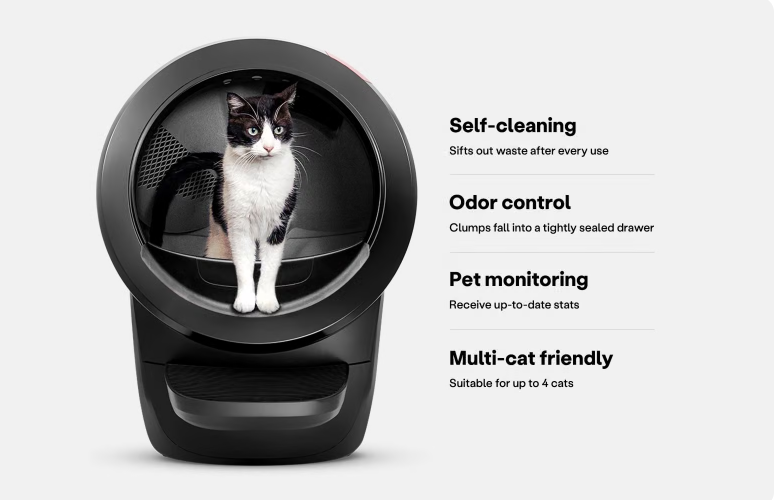
Litter-Robot is the box other automatic litter boxes get compared against. The fourth generation refined the core mechanism rather than reinventing it: a rotating globe that sifts clean litter away from waste into a sealed drawer.
What works
- Whisker publishes full specs, capacity, and warranty terms on its own product page, easy to check before committing to the $699 starting price
- Whisker states the waste drawer may need emptying as little as once every 8 days — a real quality-of-life difference from daily scooping
- Rated for up to 4 cats weighing 3–25 lbs, with SmartScale tracking of weight and usage over time
- Includes a fence, step, carbon filter, and five waste drawer liners; only the LitterTrap mat, carpet tray, and LitterHopper are sold separately
What to watch
- High upfront cost relative to disposable-tray systems, even before accessories
- Uses standard clumping litter, so litter purchases don’t go away — only the daily scoop does
- The rotating mechanism has a learning curve for some cats, and some never take to a moving box
- Whisker’s standard warranty is 1 year; a 3-year extension costs extra, so don’t assume the higher price buys better coverage
Where it fits: The Litter-Robot 4 is the lowest-priced entry into Whisker’s globe-style lineup. If you’re comfortable with the upfront cost and don’t need camera-based cat ID, it’s the straightforward choice in the line.
Litter-Robot 5 Pro
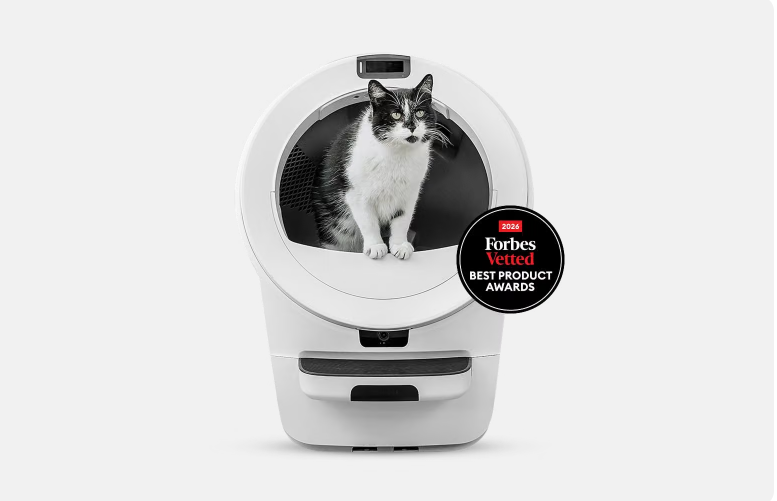
The newest addition to the Litter-Robot line builds on the same core mechanism but adds dual 1080p cameras with night vision, capable of recognizing individual cats by face — a real advantage in a multi-cat household trying to track each cat’s bathroom habits separately.
What works
- Facial recognition means health and usage data can be tracked per cat rather than lumped together, useful if you’re watching for changes in one specific cat
- Rated for up to 5 cats weighing 3–30 lbs, a wider range at both ends than the Litter-Robot 4
- Builds on the same well-tested globe mechanism as the Litter-Robot 4 rather than starting from scratch
What to watch
- The most expensive option here by a meaningful margin: $899 against $529.99–$699 for the others
- Deeper health-tracking requires an ongoing Whisker+ membership ($7.99/month, or $79.90/year after a 30-day trial). Free: SmartScale weight tracking and five minutes of live video a day. Whisker+ adds facial-recognition ID, unlimited streaming, and 30 days of video history
- The added camera hardware is only useful if you have more than one cat. Single-cat households may not get enough value to justify the price jump over the 4
Where it fits: For multi-cat households that specifically want per-cat health monitoring, the 5 Pro solves a problem the 4 can’t, at a price that reflects it. Whisker also sells a non-Pro Litter-Robot 5 at $799, covering the same up-to-5-cat range but without the cameras — the one to look at if you want the extra capacity without paying for facial recognition.
PetSafe ScoopFree
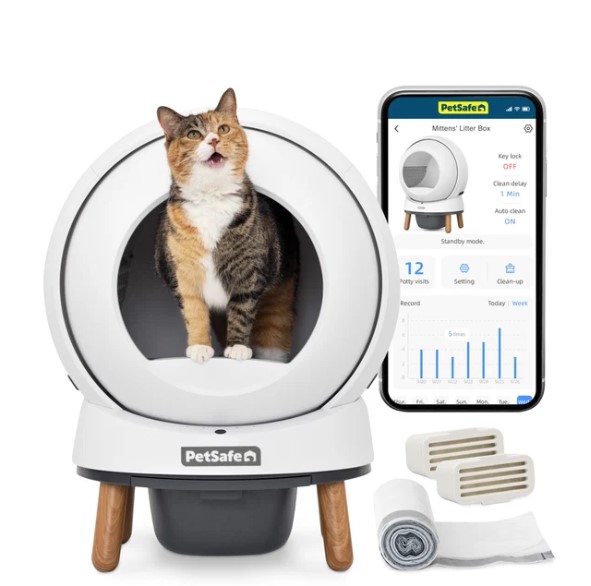
PetSafe’s ScoopFree line spans several mechanisms, not one approach: Crystal models use disposable crystal litter trays you replace as a unit, while SmartSpin and Clumping sift standard clumping litter into a waste bin instead. It’s the broadest lineup here, from a basic rake-and-tray box up to app-connected models with usage tracking.
What works
- Lower entry price than globe-style systems: $99.95 to $549.99 depending on the model
- On the Crystal models, there’s no waste drawer to empty — when a tray is done, you replace the whole thing
- Higher-tier models add app connectivity and health monitoring, so you’re not locked out of smart features at the lower price points; the SmartSpin sifts into a sealed, deodorized waste bin and logs weight and usage in the Pet Companion app
What to watch
- Disposable trays are a recurring cost on Crystal models — run that annual figure before comparing sticker prices, since a year of trays can cost more than a year of bulk clumping litter
- Lower-tier models such as the Crystal Classic are listed without app connectivity, so “smart” features vary a lot depending on which specific model you buy
- The lineup runs to eight differently named models, and the naming gets confusing fast. Read the specific feature list for the one you’re considering rather than assuming based on the name
- PetSafe’s terms are a one-year non-transferable limited warranty with a 45-day return window — shorter coverage than PETKIT lists on the Purobot Max Pro 2
Where it fits: ScoopFree’s Crystal range makes sense if avoiding a waste drawer matters more than minimizing ongoing litter costs, or if you want the lowest entry price into the category.
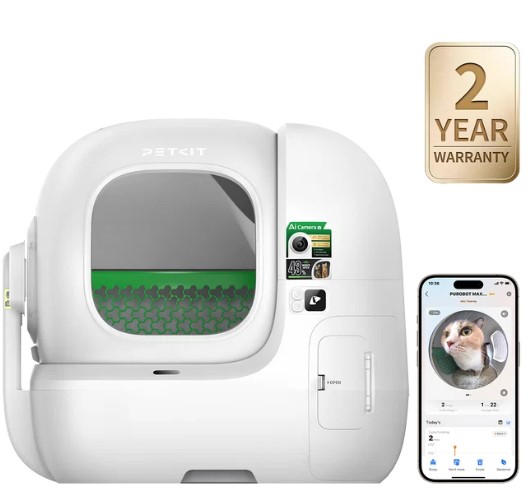
PETKIT Purobot Max Pro 2
PETKIT lists the Purobot Max Pro 2 at $599.99 ($529.99 at last check) against $899 for the Litter-Robot 5 Pro. That gap is the whole argument for this model: camera hardware and facial recognition well below the premium end of the category.
What works
- A 1080p camera with a 210° field of view and AI facial recognition for up to 15 cats, at a price below both Litter-Robot models with camera features
- Wide opening and large capacity: a 10.51″ × 10.74″ entrance (43% larger than the previous model), 76-liter cylinder, 8-liter waste bin
- Uses standard clumping litter (clay, tofu, or mixed; two sifters included), keeping costs closer to Litter-Robot than to disposable-tray systems
- Comes with a 2-year warranty, longer than the 1-year warranty on the Litter-Robot 4 or PetSafe’s 1-year limited warranty
What to watch
- Supports cats from 3.3 to 22 lbs, a lower ceiling than the Litter-Robot 4 (3–25 lbs) or the 5 and 5 Pro (3–30 lbs) — weigh your largest cat first
- PETKIT specifies litter granules under 0.47 in long and 0.12 in wide, narrower than “works with clumping litter” suggests
- The 30-day video history requires a PETKIT Care+ subscription; the free base app doesn’t retain footage that long
Where it fits: If AI camera monitoring appeals to you but the Litter-Robot 5 Pro’s price doesn’t, PETKIT is worth comparing directly, provided your cats sit inside its supported weight range.
Best-Use-Case Recommendations
Rather than naming one universal winner, here’s how these litter boxes sort by actual situation.
You want a globe-style box on regular clumping litter without paying for cameras
The Litter-Robot 4 at $699 is where Whisker’s globe-style lineup starts, covering up to 4 cats from 3–25 lbs.
You have multiple cats and want to track each one’s bathroom habits and health individually
The Litter-Robot 5 Pro is the option Whisker builds around that use case — though PETKIT’s Purobot Max Pro 2 also offers camera-based facial recognition at a lower price, so compare the two directly.
You want to avoid a waste drawer entirely, or want the lowest entry price
PetSafe’s ScoopFree Crystal models give you options at multiple price points, with the trade-off of recurring tray costs.
AI camera monitoring interests you but the premium price doesn’t
PETKIT Purobot Max Pro 2 offers similar features at a lower cost, with a lower weight ceiling (22 lbs) as the trade-off.
You have a large cat, a kitten, or one who’s likely to grow into one
Check the supported weight range before you order. The Litter-Robot 5 and 5 Pro cover the widest span at 3–30 lbs, against 3–25 lbs for the Litter-Robot 4 and 3.3–22 lbs for the Purobot Max Pro 2. Below the stated minimum, plan on a traditional box for a while.
No single system works for every cat. Some adjust within days, others take weeks, and some never take to a moving mechanism at all. Check each manufacturer’s return policy before committing — PetSafe, for example, publishes a 45-day window — especially if your cat has never used an automatic system.
A Note on Placement and Space
Easy to overlook when comparing specs online: these units are considerably larger than a standard litter box, and several need clearance space for the cleaning mechanism to operate. Check the manufacturer’s stated footprint and clearance before ordering, particularly for a smaller bathroom, closet, or laundry area — a unit wedged against a wall can’t complete its cleaning cycle the way its specs suggest.
Two more constraints belong on the same checklist: every model here needs an outlet, and because these boxes hold more litter than a standard pan, tracking tends to be more noticeable — most brands sell a mat or carpet tray separately, worth budgeting for on hard flooring.
Placement matters to the cat, not just the machine. A quiet spot that isn’t boxed into a corner tends to work better — cats generally prefer to see people or animals approaching and have more than one way out — and it’s worth keeping the box away from high-traffic areas and loud appliances that could startle a cat mid-cycle. A great spot for you and a bad spot for your cat won’t get used.
Noise, Safety, and What Happens When the Power Goes Out
A few practical questions are worth checking before you commit to a specific model rather than after:
How loud is the cleaning cycle? None of the four product pages list a decibel rating, so there’s no spec to compare. If your cat’s litter box shares a wall with a bedroom, or your cat startles easily, watch a demo video of the specific model rather than assume “self-cleaning” means “silent.”
Is there a minimum weight requirement? Yes: the models in this comparison are designed not to start a cleaning cycle while a cat is inside, which is why each one lists a minimum weight (see the recommendations above). Don’t assume every model handles this the same way, and check the current spec before using one with a kitten.
What happens if the power goes out mid-cycle? Manufacturers handle this differently, and it isn’t always spelled out. Whisker sells a separate backup battery kit for the Litter-Robot 4/5/EVO, stated to provide 24–48 hours of reserve power. Ask customer support about a specific model before buying if this matters to you.
None of this should talk you out of an automatic litter box — the point is choosing based on the questions that shape daily life with your specific cat, not the spec sheet alone.
Frequently Asked Questions
Is a multi-cat litter box actually different from a single-cat model, or is it just marketing?
A bit of both. The core mechanism is usually the same across cat counts, but “multi-cat” ratings typically reflect drawer or tray capacity, weight range, and increasingly whether the app can tell your cats apart. A unit rated for multiple cats can still need frequent attention with three — capacity claims are a starting point, not a promise of set-it-and-forget-it convenience.
Do cats take to these on their own, or does it take training?
Most cats accept a self-cleaning box readily, though not always right away; cats that startle easily can take longer, and some never take to a moving mechanism at all. If your cat starts eliminating outside the box after you switch, go back to the traditional box for a while and reintroduce the automatic one more gradually, leaving the old box available for a short overlap period. Reading a specific model’s return policy before buying is just sensible given how much cats vary.
Do I still need more than one litter box if the automatic one cleans itself?
Often, yes, if you have more than one cat: one box can’t be in two rooms if your cats prefer different locations. A second box elsewhere is also a useful fallback if the automatic one is mid-cycle, unplugged, or being avoided by one particular cat.
How much cleaning does the machine itself need?
More than the marketing implies, less than daily scooping. Beyond emptying the drawer or swapping the tray, these units accumulate dust and residue and need periodic wiping down, plus their own consumables (carbon filters, waste drawer liners) on separate schedules. Read the manual’s recommended intervals before you buy — that’s what determines whether the box actually feels low-maintenance.
Are the AI camera features on newer models worth the extra cost?
Depends on whether you have more than one cat and want their bathroom habits tracked separately. Single-cat households don’t have that problem to solve; multi-cat homes trying to spot a change in one specific cat may find it genuinely useful. Either way, treat the data as a prompt to call your vet, not a diagnosis.
Answer this question first, not the price
An automatic litter box won’t make you love cleaning up after your cat. Not much does. But it can turn a daily chore into an occasional one, and for a lot of owners, that trade is worth the upfront cost.
The right choice comes down to one distinction: minimize daily maintenance with a system you empty occasionally, or avoid the waste drawer entirely for a recurring tray cost. Answer that first, and the rest of the comparison gets a lot easier.
See our top pick: Litter-Robot 4About the author: Shiori writes about pet tech and safety gear for petloverofficial.com. She builds every comparison from manufacturers’ published specifications and support documentation rather than marketing copy, and notes when a figure can’t be verified.
This article is general information for pet owners, not veterinary advice. Health and activity data from a litter box app is not a diagnostic tool. Talk to your veterinarian about any change in your cat’s litter box habits.
Litter-Robot, Whisker+, SmartScale, LitterTrap, ScoopFree, SmartSpin, PETKIT, and Purobot are trademarks of their respective owners and are used here for identification only. This comparison is independent and is not endorsed by any of these brands.
Related guides:
- Is Cat Insurance Worth It? — what the per-cat monitoring is really watching for. A urinary blockage runs $1,500 to $3,500 as an emergency, and another $1,500 to $3,000 if it recurs and needs PU surgery, and male cats are the ones most at risk.
- Pet Cameras Without a Subscription: What You Actually Give Up — the same ongoing-fee question from criterion 3 above, asked of pet cameras, where the split is sharper: some record to a memory card and owe nothing, others save nothing at all the day you stop paying.


Leave a Reply