Dog ACL Surgery Cost
Cruciate ligament repair is one of the most common orthopedic surgeries in dogs, and the quotes for it vary widely from one hospital to the next. Here is what each repair actually costs, what sits inside the estimate, and what to do if you can’t pay it this month.
If your dog is limping right now, read this first. A policy bought today will not pay for this surgery. Every US insurer excludes conditions that showed symptoms before coverage started, and several add a waiting period of up to six months on knees specifically. Insurance is not the answer to a bill you are holding — skip to paying for it without insurance. The coverage section further down is for the dog who hasn’t torn anything yet.
What each repair costs
First, the terminology. Dogs don’t have an ACL. The ligament is the cranial cruciate ligament (CCL or CrCL), and the American College of Veterinary Surgeons describes it as the canine equivalent of the human ACL. The difference matters for your bill: in people the ligament is replaced, while in dogs it can’t be, so surgeons instead change how the knee carries load. That is why the expensive procedures involve cutting and re-plating bone.
| Repair | Typical cost per knee | Usually recommended for | Who performs it |
|---|---|---|---|
| TPLO | $3,500 – $7,000 | Most medium and large dogs, and any dog that is young or athletic. The most studied option, with 25+ years of published outcomes. | Board-certified surgeon |
| TTA | $3,000 – $5,500 | Broadly comparable to TPLO in most dogs. Fewer surgeons offer it now. | Board-certified surgeon |
| CBLO | $3,500 – $6,500 | Young dogs whose growth plates haven’t closed. | Board-certified surgeon |
| Lateral suture extracapsular repair |
$1,500 – $3,000 | Small dogs, typically under about 30 lb. ACVS notes the usual complication is failure of the suture itself, and that it suits larger, younger dogs poorly. | Often a general practice vet |
Cheaper is not always cheaper. A lateral suture placed in a 70 lb dog can loosen or fail within the first year, and the revision surgery is usually a TPLO — at full price, on a knee that now has more arthritis in it. The size cutoff exists for a reason.
Where the money actually goes
Most of what people call “the surgery cost” is one line on a page of ten. Ask for the itemized estimate in writing before you agree to anything — it is the single most useful thing you can do, because it tells you what is bundled and what will arrive as a separate invoice later.
| Line item | Typical | What to ask |
|---|---|---|
| Orthopedic consult | $75 – $150 | Is it credited toward surgery if you proceed? |
| Pre-op radiographs | $150 – $400 | Is sedation included, or billed separately? |
| Pre-anesthetic bloodwork | $75 – $200 | Can your regular vet run it for less? |
| Anesthesia and monitoring | $300 – $600 | Priced by the hour or flat? |
| Surgery and implants | $2,000 – $4,000 | The plate and screws are inside this figure. |
| Meniscus treatment | $300 – $800 | Only if the cartilage is torn — and it often is. |
| Hospitalization | $200 – $500 | Usually one night. |
| Take-home medication | $50 – $150 | Can it be filled at an outside pharmacy? |
| Recheck X-rays at ~8 weeks | $100 – $200 | Often already in the surgical package. |
| Formal rehabilitation | $50 – $100 per session | Six to twelve sessions is common. Rarely included. |
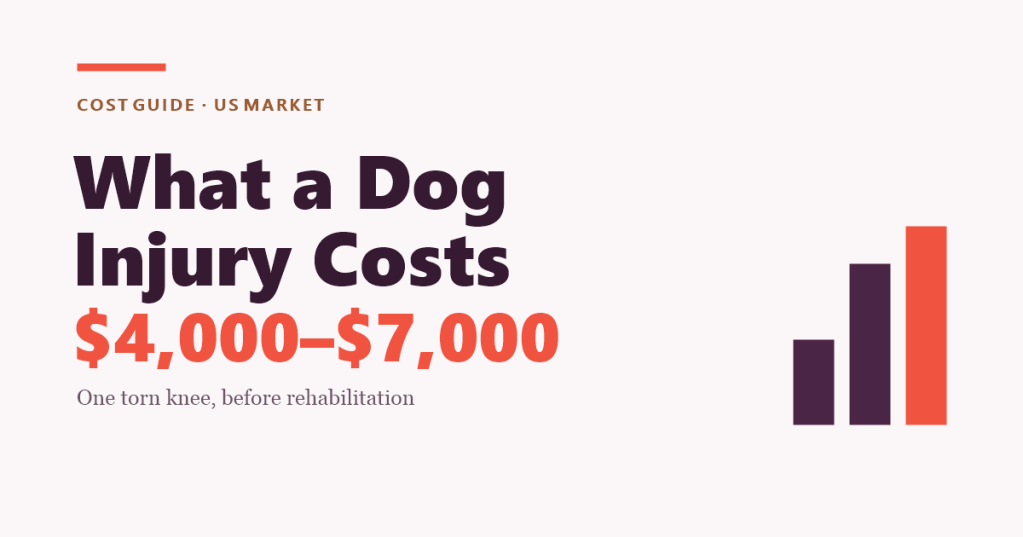
Add it up and an uncomplicated TPLO lands somewhere around $4,000 to $7,000 per knee before rehabilitation. Recovery runs eight to twelve weeks of strictly restricted activity, with follow-up X-rays around week eight to confirm the bone has healed.
Why quotes differFour things that move the number
Who holds the scalpel
A board-certified veterinary surgeon costs more than a general practitioner who performs the occasional cruciate repair, and for a bone-cutting procedure that premium buys volume of experience. University teaching hospitals often quote below private specialty centers for the same operation — it is worth one phone call to the nearest one.
Your dog’s weight
Bigger dogs need larger implants, more anesthetic drug, and longer table time. Many practices add an explicit large-breed surcharge. Weight also decides which procedures are on the table at all.
Where you live
Specialty hospitals in coastal metros consistently charge more than clinics in the Midwest and Southeast. Driving two hours for a consult is, for this particular surgery, sometimes worth four figures.
What they find inside the joint
Roughly a third of dogs have a torn meniscus at the time of cruciate surgery. It is usually confirmed once the joint is open, which means it lands on the invoice as a change to an estimate you already approved. Ask in advance what a meniscal tear would add.
Outcomes, at least, are consistent. ACVS reports significant improvement in 85–90% of dogs after surgical repair. Published complication rates for TPLO range from roughly 10% to more than 30% depending on the study and how complications are counted, most of them minor; fewer than one dog in ten needs a second surgery.
Budget for thisThe other knee is the part nobody warns you about
Cruciate disease in dogs is usually degenerative rather than traumatic — the ligament frays over months before it gives out. Whatever caused it on one side is generally at work on the other side too.
ACVS puts it plainly: 40–60% of dogs that have cruciate disease in one knee will develop the same problem in the other knee. Published follow-up studies land in the same territory, with one series finding 48% of Labrador Retrievers ruptured the second side at a median of 5.5 months. So the realistic question is not “can I afford $5,000,” it is “can I afford $5,000 twice, possibly within the year.”
The insurance trap hiding in that statistic. Many policies carry a bilateral exclusion: if one knee was affected before your coverage started, the other knee is treated as part of the same pre-existing condition and is excluded too. That turns a single tear into a permanently uninsurable pair. Insurers handle this differently, and the difference is worth thousands. Pumpkin, for one, spells it out: if a knee or hind-leg ligament problem starts before coverage or during the waiting period, future ones are not covered. Ask the question in these exact words before you buy: “If my dog has already torn one cruciate ligament, will you cover the other knee?” Get the answer in writing.
Does every dog need the surgery?
For a large, active dog, surgery is the standard of care and the evidence behind it is strong. For a small dog, the picture is genuinely less one-sided, and it is the one place in this whole process where you may be able to spend far less without shortchanging your dog.
The reference point is still a 1984 study by Vasseur, which followed dogs managed without surgery: 86% of dogs weighing 15 kg (33 lb) or less were normal or improved at an average of three years, against 19% of dogs over 15 kg. A 2024 prospective study comparing TPLO with conservative management in dogs under 10 kg found no significant difference in pain or lameness scores over twelve weeks — though only the surgical group regained thigh muscle mass, which matters over a lifetime.
Conservative management is worth discussing
- Small dog, roughly under 30–33 lb
- Partial tear rather than a complete rupture
- No meniscal damage on examination
- You can genuinely enforce 6–8 weeks of restricted activity
- Weight loss is available as a lever
Surgery is the stronger call
- Medium or large dog, or a young athletic one
- Complete rupture with obvious joint instability
- Meniscal injury suspected or confirmed
- Lameness that has not improved after weeks of rest
- A working or sporting dog expected to return to full load
Conservative management is not “doing nothing.” It means weeks of leash-only activity, anti-inflammatories prescribed by your vet, weight control, and rechecks — and if the dog is not better after that, you have spent the time and still face the surgery. Have the conversation with your vet rather than with a search engine.
CoverageWhat insurance pays — if you bought it in time
Accident-and-illness policies cover cruciate surgery, and at 80–90% reimbursement a $6,000 knee becomes a $600–$1,200 knee plus your deductible. The catch is timing. Knees are the body part insurers most often single out for a longer waiting period, precisely because cruciate disease is so common and so expensive.
| Insurer | Wait before knees are covered | Can it be shortened? |
|---|---|---|
| ASPCA | 14 days — no separate orthopedic wait | Nothing to shorten |
| Trupanion | 30 days — no condition-specific waits | Nothing to shorten |
| Embrace | 6 months for cruciate and other listed orthopedic conditions | Down to 14 days with an orthopedic exam early in the policy, in states that allow it |
| Pets Best | 6 months, cruciate specifically | Waivable with an exam 3 days before to 7 days after the start date |
| Pumpkin | 14 days — no separate orthopedic wait | Nothing to shorten |
| Fetch | 6 months, hips and knees | May be waived with a vet exam early in the policy |
Three policies that start covering knees soonest
ASPCA
Fourteen days for everything, with no separate orthopedic clause to read past. If a large-breed puppy is the dog you’re insuring, this is the simplest answer.
Get a quoteEmbrace
Six months on paper, but in many states an orthopedic exam early in the policy cuts it to fourteen days — and the plan itself is one of the most adjustable of the six we compared.
Get a quotePumpkin
Knees and hips are covered after the same 14-day wait as everything else, and exam fees are included. One catch: a ligament problem that starts before or during the wait rules out future ones.
Get a quoteHow to pay for it without insurance
Most people reading this are already past the point where a policy helps. These are the levers that are actually left, roughly in the order worth trying.
1. Get a second estimate
Prices for the identical procedure vary by thousands between practices in the same region. Take your existing radiographs to a second surgeon — you are paying for another consult, not another workup, and the spread is frequently larger than the consult fee by an order of magnitude.
2. Call a university teaching hospital
Veterinary schools perform these operations constantly, supervised, and often quote below private specialty centers. Waiting lists are the trade-off.
3. If your dog is small, ask about the alternatives
For a dog under roughly 30 lb, ask your vet directly whether a lateral suture — or a supervised conservative plan — is reasonable in this case. The difference is $1,500 against $5,000, and for the right dog the outcome data does not clearly favor the expensive option.
4. Payment plans and medical credit
Many hospitals accept CareCredit, and most promotional periods are deferred interest: clear the full balance inside the window or interest can be charged back to day one. Scratchpay offers fixed installment plans and its application is a soft credit check. Some practices will arrange an in-house plan if you ask, which is always cheaper than either.
5. Grants and crowdfunding
RedRover Relief makes small urgent-care grants, typically around $250, with fast turnaround. Brown Dog Foundation works with your clinic to close the remaining gap and expects you to have applied elsewhere first. Waggle is a nonprofit crowdfunding platform that pays the hospital directly rather than paying you. Apply to several the same day — these are small amounts that only work stacked. Best Friends Animal Society maintains a long list of regional and breed-specific programs.
What owners ask next
Is it an ACL or a CCL?
Clinically it’s the cranial cruciate ligament. “ACL” is borrowed from human medicine and every vet will know what you mean, so the word isn’t worth arguing about. What is worth knowing is why the repair differs: a human ACL gets replaced, a dog’s can’t be, so the surgeon alters the geometry of the joint instead. That’s what you’re paying for.
Can my dog live with a torn cruciate?
A small dog often can. In the reference study, 86% of dogs 33 lb and under were normal or improved without surgery, against 19% of larger dogs. But an unstable knee keeps developing arthritis, and a torn meniscus is painful in a way rest does not fix. This is a decision for your vet with the leg in front of them, not a decision to make on cost alone.
Why is TPLO double the price of a lateral suture?
Because it’s a different class of operation. TPLO cuts and rotates the top of the tibia and fixes it with a titanium plate, which means a board-certified surgeon, longer anesthesia, implants, and follow-up X-rays to confirm the bone healed. A lateral suture stabilizes the joint from outside with heavy suture material and can often be done by a general practice vet in under an hour.
Does the plate ever come out?
It usually stays. ACVS notes the plate and screws are no longer needed once the bone has healed, but they’re generally left in place unless they cause a problem such as infection or irritation. Removal is a second, smaller surgery.
How long is recovery?
Eight to twelve weeks of strictly restricted activity, with recheck X-rays at around week eight to confirm bone healing. The restriction is not negotiable — doing too much too early is one of the most common reasons repairs run into trouble. Budget for a crate, a sling, and a household that can manage stairs.
Will insurance cover the second knee?
It depends entirely on the policy, and this is the single most expensive detail in the fine print. If the first tear happened before your coverage started, some insurers apply a bilateral exclusion and treat both knees as pre-existing. If the first tear happened while you were already insured, the second knee is generally covered like any new condition. Ask before you buy, and get it in writing.
Plan for two knees, not one
Budget $4,000 to $7,000 for an uncomplicated TPLO, plus rehabilitation, and treat the 40–60% chance of the other side going as part of the plan rather than as bad luck. Ask for the itemized estimate, get a second one, and ask what a meniscal tear would add before you sign.
If you’re reading this about a dog who is still sound — a large-breed puppy, a young Labrador, a Rottweiler — this is the bill that pet insurance exists for, and the waiting period on knees means the only useful time to buy is long before there’s anything to claim.
Compare six pet insurersDaisuke
Daisuke writes about pet insurance and the cost of veterinary care for petloverofficial.com. He builds each comparison from insurers’ own policy documents and help pages rather than their marketing pages, cross-checks against independent reviews where an insurer doesn’t publish a figure, and says plainly when a number is an estimate.


Leave a Reply