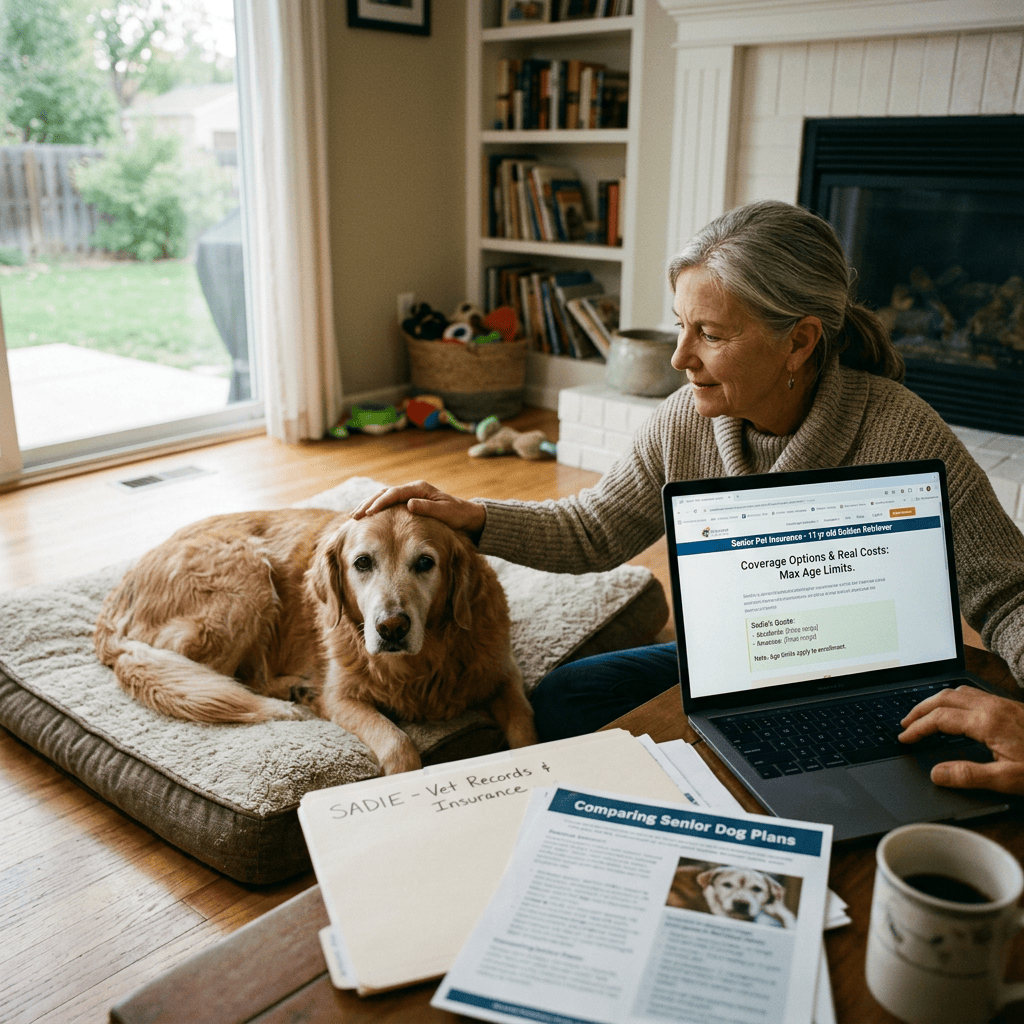
Pet Insurance for Older Dogs: Is It Too Late?
Usually not — all six insurers we track will still take a twelve-year-old, and four have no upper age limit at all. The harder question is whether dog insurance bought at that age will pay for anything your dog is actually likely to need, and that answer turns entirely on what is already in the medical record.
The short version. Enrolling a senior dog is easy. Getting value out of it is not. A new policy covers new problems only, and by eight or nine most dogs have something on file — a grade 2 murmur, stiff hips, a line about tartar. Each of those quietly closes off the conditions most likely to send you to the vet. Insurance at this age is a bet on the illness your dog hasn’t developed yet, and it can still be a good bet. Just know which bet you’re placing.
Which insurers still cover senior and elderly dogs
Age caps are the first filter, and they vary more than you’d expect. Four of the six insurers in our main comparison have no upper limit at all.
| Insurer | Oldest age you can enroll | What changes for a senior |
|---|---|---|
| ASPCA | No upper limit | Nothing structural. 14-day wait, and no separate orthopedic waiting period — which matters when stiff joints are the reason you’re shopping. |
| Pumpkin | No upper limit | One 14-day wait for everything, knees and hips included, and exam fees are covered too. Reimbursement is 80% or 90% only, so there’s no cheap tier to fall back on. |
| Pets Best | No upper limit | Keeps the 70% tier and deductibles up to $1,000, which is how you hold the monthly cost down at this age. |
| Fetch | No upper limit | Exam fees and dental illness stay in the base plan. Accidents are covered from day one; hips and knees wait six months. |
| Trupanion | Up to the 14th birthday | Still 90% with no payout cap, and still pays the hospital directly. Exam fees are never covered. |
| Embrace | 14 for accident and illness 15+ accident-only |
From 15, only the accident-only plan is available — but that plan itself has no age limit, and coverage continues for life once enrolled. |
Three insurers that make sense for a senior dog
ASPCA
No age cap, 14 days to full coverage, and no six-month orthopedic lockout — the clause that makes many policies useless to an arthritic dog in year one.
Get a quotePumpkin
Exam fees included and no separate orthopedic wait, both of which matter when a senior dog’s year turns into a series of appointments.
Get a quotePets Best
The 70% reimbursement tier and a $1,000 deductible option let you buy real catastrophic cover without a premium that climbs out of reach by fourteen.
Get a quoteWhat pet insurance for an older dog costs
Age moves the premium more than anything else you can control. NAPHIA puts the 2025 average for an accident-and-illness dog policy at $836 a year — about $70 a month — across all ages. An eight-plus dog sits well above that line, and a large breed sits above it again.
| Dog, 8 years and up | Accident only | Accident + illness |
|---|---|---|
| Small, under 25 lb | $25 – $42 | $84 – $140 |
| Medium, 25 – 55 lb | $32 – $53 | $105 – $175 |
| Large, 55 – 90 lb | $38 – $63 | $126 – $210 |
| Giant, over 90 lb | $46 – $76 | $152 – $254 |
Two levers bring that down without gutting the policy: take the 70% reimbursement tier instead of 90%, and take the largest deductible you could absorb in one go. You are not insuring a $400 dental — you are insuring the $6,000 year.
The real constraintWhat “pre-existing” means for an older dog
Every US insurer excludes conditions that showed signs before coverage began. For a puppy that’s an abstraction. For a senior dog it is the whole story, because the exclusion attaches to anything documented — not just anything diagnosed.
A note in last year’s records saying “mild stiffness in the hind end” can exclude arthritis. A recorded heart murmur can exclude the valve disease it turns out to signal. Vomiting written up as an upset stomach can be read as an early sign of the kidney disease found two years later. None of that requires a formal diagnosis, and you generally won’t find out where the line was drawn until you file the claim.
Do this before you buy. Ask your vet for your dog’s complete medical records and read them yourself. Insurers request the same file after your first claim, so you are simply reading it first. If the record is clean, a senior policy is worth pricing. If it already names the thing you’re worried about, you now know that thing will not be covered by anyone — and you can stop shopping and start saving instead.
One nuance worth knowing: some insurers will reconsider a condition your vet classes as curable after a symptom-free window, often 180 days — five of the six insurers we track will cover a cured condition again, four of them after a published symptom-free window. Chronic conditions — arthritis, heart disease, kidney disease, diabetes, allergies — stay excluded for life. Those are precisely the conditions a senior dog gets.
The risk you’re insuringWhat actually happens to older dogs, and what it costs
This is the part worth budgeting against, whether you buy a policy or not.
| Condition | How common in senior dogs | Typical cost |
|---|---|---|
| Cancer | The Veterinary Cancer Society says almost 50% of dogs over 10 will develop cancer, and roughly 1 in 4 dogs at some point in life | Synchrony’s 2025 study puts the US average for a lymphoma course at $5,254, from $4,231 in West Virginia to $9,387 in Hawaii — see what dog cancer treatment costs |
| Dental disease | The most common reason a senior dog goes under anesthesia | $700 – $1,350 typical; $1,200 – $2,500 when several teeth come out |
| Osteoarthritis | In UK primary-care records, dogs over 12 had about 54 times the odds of a diagnosis compared with dogs under 3; earlier research puts more than half of diagnosed dogs between 8 and 13 | Monthly injections such as Librela run roughly $85 – $220, so $1,000 – $2,600 a year plus exams |
| Heart disease | Mitral valve disease accounts for around 75% of diagnosed canine heart disease, and the murmur that signals it becomes common in older dogs, especially small breeds | Cardiology workup $400 – $800, recheck echocardiograms $400 – $600, medication $30 – $200 a month for life |
| Cushing’s disease | Largely a disease of middle-aged and older dogs | $400 – $800 to diagnose, trilostane $80 – $250 a month, roughly $1,500 – $5,000 in year one |
| Chronic kidney disease | Rises steeply with age | $200 – $750 to work up, then $100 – $500 a month to manage |
Read that table twice and the shape of the problem appears. Senior dog medicine is rarely one $6,000 event, the way a torn cruciate ligament is. It’s $150 a month, for years, across two or three conditions at once — and that pattern is much harder to insure, because chronic conditions are the ones exclusions catch first.
Cancer is the exception that behaves like neither: a diagnostic workup of $700 to $2,000 before anyone decides anything, then a course of treatment averaging a little over $5,000 for lymphoma and running well past $20,000 for the aggressive cancers. It is also the one an older dog is most likely to meet. We broke the whole bill down in dog cancer treatment cost.
The decisionWhen it’s worth buying, and when it isn’t
Worth pricing a policy
- The medical record is genuinely clean
- Your dog is 8–10 rather than 13, so there are years of premiums to run
- A large or giant breed, where every bill scales with body weight
- You could not write a $7,000 check next month without real damage
- A breed with a known cancer risk — a Golden Retriever, a Boxer, a Bernese
Save the money instead
- The record already names the condition you’re worried about
- Your dog is 13 or 14 and the premium is above $200 a month
- You have savings you would genuinely spend on treatment
- You have already decided against chemotherapy or major surgery at this age
- Only an accident-only plan is available and your dog rarely leaves the house
The honest arithmetic: a senior policy at $150 a month costs $1,800 a year. If your dog lives another four years insured, that’s $7,200 in premiums plus deductibles and your share of every claim. That is roughly one cancer course. The policy wins if your dog gets the cancer, and loses if your dog quietly declines — which is the same trade as any insurance, just with the odds compressed into a shorter window and a thinner list of covered conditions.
One caveat nobody markets. “Insured for life once enrolled” is the standard promise, and for most insurers it holds — a policy can’t be dropped for filing claims or for getting old. But it isn’t a legal guarantee. In June 2024, Nationwide announced it would not renew around 100,000 pet policies, with those non-renewals landing through 2025. The company said age, breed and claims history were not factors, but owners of older pets with pre-existing conditions were left with nothing to move to, because a new insurer would treat every existing condition as excluded. It is a small risk. It is not zero, and it is worth knowing before you treat a policy as permanent.
If insurance isn’t the answer
Fund it yourself, deliberately
Open a separate account and set up the transfer you would have paid in premiums. At $150 a month you have $1,800 after a year and $7,200 after four — the same money, available for the pre-existing conditions no policy will touch, and yours if it goes unspent. The catch is timing: the fund is small in year one, which is exactly when an eleven-year-old is already at risk.
Accident-only, as catastrophe cover
If the illness side is closed off by pre-existing conditions anyway, an accident-only plan still covers the things that have nothing to do with age — a fracture, a laceration, a swallowed object. It is a fraction of the price, and for a dog with a thick medical file it is sometimes the only honest product left.
Wellness plans are not insurance
A wellness add-on or an in-house clinic plan prepays routine care — exams, vaccines, bloodwork — and is priced to roughly break even. For a senior dog on twice-yearly monitoring it can smooth the budget, but it will not pay for the chemotherapy. Don’t buy one believing you’ve bought cover.
Financing, when the bill is already here
CareCredit is widely accepted, and its promotional periods are usually deferred-interest — clear the full balance in the window or interest can be charged back to day one. Scratchpay offers fixed installments with a soft credit check. Ask the practice about an in-house payment plan first; it’s almost always cheaper than either.
What owners of older dogs ask
At what age is a dog “senior”?
There’s no fixed line, and insurers don’t use one — they price continuously by age. Clinically, large and giant breeds are usually considered senior around six or seven, small breeds closer to ten. What matters for a policy isn’t the label but the record: a clean nine-year-old is a better candidate than a seven-year-old with three chronic conditions on file.
Which dog insurance companies have no upper age limit?
Of the six we track, ASPCA, Pumpkin, Pets Best and Fetch will enroll a dog of any age. Trupanion stops at the fourteenth birthday, and Embrace stops accident-and-illness cover at fourteen but keeps an accident-only plan open with no age limit at all. Outside this group, a cap at 13 or 14 is common, so check the age section before you fill in a quote form.
Is pet insurance worth it for an elderly dog?
It turns far less on the age than on the file. For an elderly dog with a clean record, a policy still covers the cancer, the swallowed object and the sudden kidney crash, and those are the bills that break budgets. For an old dog whose record already names arthritis, a heart murmur or rising kidney values, most of what you would be insuring against is excluded before you start — and the same money is worth more in an account you control.
Will the premium keep going up?
Yes. Pet insurance is age-rated, so the price rises at each renewal as your dog gets older, and separately as veterinary costs rise across the market. Budget for a premium meaningfully higher at fourteen than at nine. Choosing a lower reimbursement rate and a higher deductible at the outset gives you room to absorb that.
Can they drop my dog for getting old or for claiming?
As a rule, no — once enrolled, coverage continues for life as long as you keep paying, and claims don’t disqualify you. The exception is a company-wide withdrawal, which is what Nationwide did in 2024 with about 100,000 policies. Rare, but it happened, and there is no equivalent of the Affordable Care Act protecting pets with pre-existing conditions if it happens to you.
Is a vet exam required to enroll a senior dog?
Often, and where it isn’t required it’s still worth doing. Several insurers ask for a recent exam for older pets, and some use one to shorten or waive waiting periods. The exam also tells you what’s already in the record — which is the single most useful piece of information before you buy anything.
My dog already has arthritis. Is there any point?
The arthritis itself won’t be covered by anyone. A policy would still cover the cancer, the swallowed sock, the sudden kidney crash — everything unrelated and undocumented. Whether that’s worth $150 a month is a judgment about your own finances, not about your dog. Many owners in this position take accident-only cover, or none, and save instead.
Does insurance cover senior wellness bloodwork?
Not on a standard accident-and-illness plan. A senior panel — CBC, chemistry, thyroid, urinalysis — typically runs $120 to $300 and counts as routine care, which means a wellness add-on or nothing. If bloodwork is ordered to investigate a covered illness rather than as a screen, that’s different and is usually reimbursed. The same goes for diet: a senior formula is an ordinary household cost, and what the label on the bag actually promises is worth reading, but no policy pays for it.
Read the record, then decide
Age is rarely what stops you — four of these six insurers will take a dog of any age, and Embrace keeps an accident-only door open past fifteen. What stops you is the file at your vet’s office, and you can read it today for the price of a request.
If it’s clean and your dog is eight or nine, price a policy with a 70% reimbursement rate and a high deductible, and treat it as cover for the catastrophic year rather than the routine one. If the file already names the thing you fear, no insurer will help with it — and the most useful thing you can do is open a separate account and start paying yourself the premium instead.
Compare six pet insurersDaisuke
Daisuke writes about pet insurance and the cost of veterinary care for petloverofficial.com. He builds each comparison from insurers’ own policy documents and help pages rather than their marketing pages, cross-checks against independent reviews where an insurer doesn’t publish a figure, and says plainly when a number is an estimate.


Leave a Reply