Does Pet Insurance Cover Pre-Existing Conditions?
No US insurer covers a chronic condition your pet already has — but “already there” is a narrower idea than most owners assume. Five of the six insurers we track will cover a cured condition again, four of them after a published symptom-free window, and one insurer outside that six advertises coverage of incurable pre-existing conditions after a year. Whether your pet’s file closes a door permanently or only for a while turns on one distinction.
The short answer. Mostly no — but less absolutely than the flat “no” you will read elsewhere. Three things matter more than the headline. A condition only has to be curable for five of the six insurers we track to cover it again. The exclusion attaches to the condition, not to your pet, so everything else stays insurable. And when an insurer denies a claim on these grounds, the law in fifteen states currently puts the burden of proving it on the insurer, not on you.
What actually counts as pre-existing
The NAIC Pet Insurance Model Act, which seventeen states have now enacted statutes based on, defines it in three prongs. A condition is pre-existing if, before the policy took effect or during any waiting period, any one of these is true:
| Prong | What it means in practice |
|---|---|
| A veterinarian provided medical advice | A conversation is enough. “Keep an eye on that limp” in the notes can do it. |
| The pet received previous treatment | Including treatment that worked and was never repeated. |
| The pet had signs or symptoms directly related to the condition for which a claim is being made | Based on information from verifiable sources. No diagnosis is required — this is the prong that surprises people. The tail matters too: the signs must relate to this claim, not to anything at all. |
Two consequences follow from that third prong, and they are the ones that cost people money.
You do not need to have known. Pets Best states it plainly: a condition can be pre-existing without a diagnosis, because what matters is when the condition began, not when someone named it. Vomiting written up as an upset stomach two years ago can be read as the first sign of the kidney disease found later.
The waiting period counts as “before”. Anything that appears between the day you pay and the day cover starts is pre-existing. A 14- or 15-day illness wait is not a free trial — it is two weeks in which a new symptom permanently closes off that condition.
The distinction that decides itCurable versus incurable
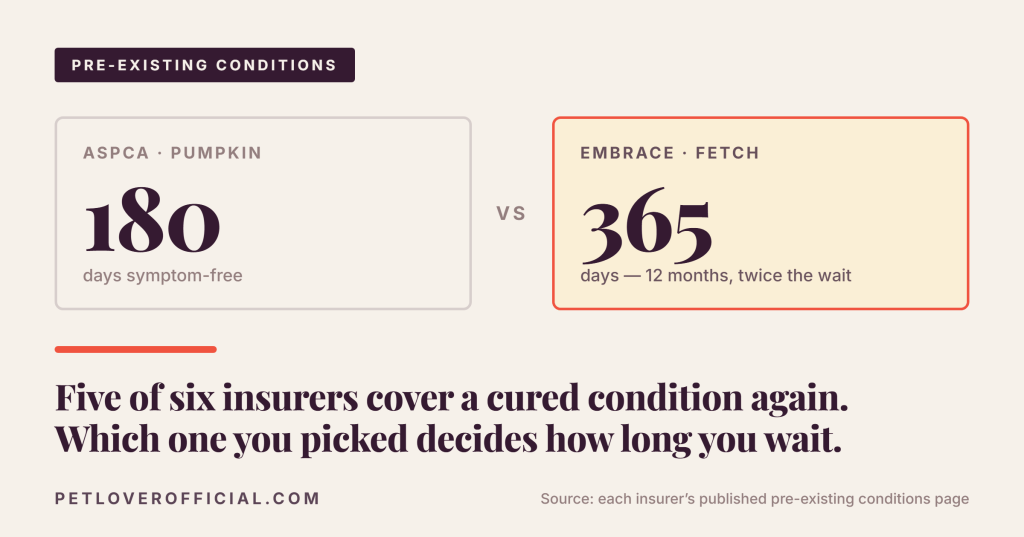
This is the whole article in one table. An incurable pre-existing condition is excluded for life at every insurer here. A curable one is excluded only until your pet has gone long enough without it — and among the four that publish a window, its length varies by a factor of two.
| Insurer | When a cured condition becomes coverable again | Knees and ligaments |
|---|---|---|
| Pets Best | Once healed or cured. Pets Best’s coverage page states such conditions are “no longer considered pre-existing” and can be covered if they recur, and names no symptom-free window. | No bilateral clause published |
| ASPCA | 180 days symptom-free and treatment-free | Permanent A knee or ligament condition before the effective date or during a waiting period excludes all future ones |
| Pumpkin | 180 days symptom-free and treatment-free | Permanent Same wording as ASPCA |
| Embrace | 12 consecutive months symptom-free and treatment-free | Recurrence on the opposite side is not covered |
| Fetch | 1 year completely symptom-free, which may fall in the first or second policy year. Fetch classes torn ligaments as incurable, so the window never applies to them. | A cruciate tear on the other side is pre-existing if the first one predated enrollment |
| Trupanion | No reinstatement window is published. Trupanion’s own example states a condition diagnosed before the policy is not eligible “even if they’ve gone years between showing signs.” | No bilateral clause published |
Usually treated as curable
- Upper respiratory infections
- Urinary tract infections
- Single, resolved ear infections
- Bite wounds and lacerations
- Broken bones, once healed
- Most one-off gastrointestinal upsets
Treated as incurable, and excluded for life
- Cancer
- Diabetes
- Heart disease
- Arthritis and other bone and joint conditions
- Allergies
- Thyroid imbalances
- Urinary crystals and blockages
- Lipomas and skin lumps
One knee can exclude the other
Bilateral conditions — the ones that come in pairs — get their own rule, and it is harsher than the general one. If your dog tore a cruciate ligament in the left knee before the policy started, four of the six insurers here publish a clause treating a future tear in the right knee as pre-existing too, on the reasoning that the first tear made the second more likely. ASPCA and Pumpkin go furthest, excluding all future knee and ligament conditions permanently. Pets Best and Trupanion publish no bilateral clause on their pre-existing pages, which is not the same as not having one — check the policy.
This matters because cruciate disease is one of the most common expensive orthopedic problems in dogs, and the second knee frequently follows the first. We costed that out separately in dog ACL surgery cost. If your dog has already had one knee repaired, read the bilateral clause of any quote before you buy it — for this specific risk, the policy may be worth very little.
The same logic is commonly applied to hip dysplasia, cataracts, glaucoma, luxating patellas and ear infections.
How far back they lookThe lookback period, and the one state that limits it
Most insurers look at your pet’s entire recorded veterinary history. Three exceptions are worth knowing, because they are the difference between an old note mattering and not.
| Who | How far back |
|---|---|
| Most insurers, most states | The whole record |
| Fetch | Requests medical records from the year before sign-up |
| Embrace | Requires a full 12-month pre-policy medical history including chart notes, and an exam within 14 days if there was no vet visit in that year |
| Trupanion | Signs or evidence within the 18 months before the effective date or waiting periods |
| Any insurer, in Vermont | 180 days — advised on, treated, or showing symptoms within 180 days before the effective date or during any waiting period |
Read the file first — it takes one email
Ask your vet for your pet’s complete medical records, and read them yourself. The insurer will request the same file after your first claim, so you are simply reading it before they do. You are looking for three things: anything already named as a diagnosis, anything described as recurring, and any soft observation — “mild stiffness”, “grade 1 murmur”, “occasional loose stool” — that could later be read as the first sign of something chronic.
If the file is clean, buy the policy and the exclusion stays theoretical. If it already names the thing you are worried about, you now know which insurers will still help — and which product, if any, is aimed at you.
Shortening the waiting period, and what that does not do
The waiting period is the one window where a new problem becomes a permanent exclusion through nothing but timing. Two of the insurers here let you shorten or remove it with a vet exam.
Pets Best: waive the waiting periods entirely
Have a vet examine your pet within three days before or seven days after your policy effective date, covering all body systems and parts, and return the health assessment form within 30 calendar days of that exam. The waiting period is then waived back to the effective date, or to the day after the exam, whichever is later.
What it does not do: the form itself says the waiver “does not alter the pre-existing conditions exclusion.” Anything the exam finds is still pre-existing. Waiving the wait protects you against something that starts next week — not against what is already there.
Embrace: cut the orthopedic wait, in some states
Embrace’s six-month wait on knee, hip and spine conditions can be reduced to as few as 14 days in some states with an orthopedic exam. Embrace says the exam must be completed within the first 14 days of the policy to pull the wait back that far; a later exam only reduces it to the exam date. Some states offer no reduction at all, and Embrace publishes the detail behind a state selector rather than as a list.
The caveat that matters here: cruciate ligament injury, IVDD, patellar luxation and hip dysplasia discovered during the waiting period are permanently excluded regardless of the waiver. The exam shortens the window; it does not undo what the window catches.
The statutory backstop
The NAIC model act caps illness and orthopedic waiting periods at 30 days, prohibits them altogether for accidents, and requires that any exam an insurer demands to waive a wait must not “unreasonably restrict” your ability to do so. Those provisions travel together in the state statutes that enacted them, so where an illness wait is capped, accident waits are banned as well. In states without a pet insurance statute, the contract decides.
The burden of proof is on the insurer, not on you
This is the most useful sentence in the model act, and almost nobody knows it is there.
“The pet insurer has the burden of proving that the preexisting condition exclusion applies to the condition for which a claim is being made.” — NAIC Pet Insurance Model Act §5.A. Sixteen of the seventeen adopting states enacted this provision; Mississippi’s statute has no policy-conditions section at all. Fifteen of those sixteen are in force today, with New Jersey’s arriving on 1 January 2027.
In practice that means a denial resting on an ambiguous line in an old record is contestable. If a claim is denied as pre-existing:
What to do
- Ask in writing which specific record entry the denial rests on
- Ask your vet to write a letter stating whether the two conditions are medically related
- Point to the burden-of-proof provision if your state has one
- Escalate to your state’s department of insurance if the insurer will not engage
What not to bother with
- Arguing that you did not know about the condition — knowledge is not the test
- Arguing that it was never formally diagnosed — diagnosis is not the test either
- Switching insurers to escape the exclusion — the next one reads the same file
A vet’s letter is the strongest single document here. Insurers do assess whether conditions are genuinely connected — Trupanion, for example, describes covering a hip problem despite an earlier sprain on the same side, on the basis of a “medical disconnect” between the two.
Three worth pricing when the record isn’t clean
Pets Best
States that a cured condition is no longer pre-existing, with no symptom-free window named on its coverage page, and lets you waive the waiting periods with a qualifying exam. Confirm the wording in the policy before you rely on it.
Get a quoteASPCA
Half the wait of Embrace or Fetch before a cured condition becomes coverable again. The knee and ligament exclusion is permanent, so this is the wrong plan for a dog with a repaired cruciate.
Get a quoteEmbrace
Twelve months is a longer wait, but Embrace publishes its curable and incurable lists plainly, and in some states an early orthopedic exam cuts the six-month knee wait to as few as 14 days. Knowing exactly where you stand has value of its own.
Get a quoteWhat is actually available to you
The one insurer that covers incurable pre-existing conditions
AKC Pet Insurance is the exception to this whole article. Its accident-and-illness plans cover pre-existing conditions after 365 days of continuous coverage, and after 180 days for cruciate ligament illness and intervertebral disc disease. The conditions it names on its own pre-existing conditions page are not the minor curable ones — they include cancer, heart disease, diabetes, arthritis, hip and elbow dysplasia, hypothyroidism, Cushing’s disease, Addison’s disease, allergies, dermatitis, cherry eye, chronic ear infections, conjunctivitis, colitis and IBS/IBD. Those are precisely the conditions every other insurer here excludes for life.
Read the qualifiers before you count on it. AKC states the provision is not available in all states. A year of continuous premiums is a long wait if your pet needs treatment now, and a gap in coverage restarts the clock. Its own FAQ describes the qualifying set more loosely than the dedicated page does, so confirm your pet’s specific condition in writing before you buy. We have not read the provision in a policy document, only on AKC’s published pages.
If your pet has a diagnosed chronic condition and you are prepared to pay for a year before it helps, this is the only product in the US market built for you, and it belongs on your shortlist ahead of the six we track.
A standard policy still covers everything else
The exclusion attaches to the condition, not to the animal. A dog with diagnosed arthritis is still insurable against cancer, a swallowed sock and a sudden kidney crash — which are the bills that break budgets. Whether that is worth the premium is a question about your finances, not about your dog.
Accident-only, when the illness side is closed
If the record already names the chronic conditions you are worried about and the 365-day route does not suit, an accident-only plan still covers fractures, lacerations and swallowed objects at a fraction of the price. For a pet with a thick file it is sometimes the most honest product left.
Pay yourself the premium instead
For a condition no insurer will touch, a separate account funded with what the policy would have cost is the honest alternative. At $70 a month that is $840 after a year and $3,360 after four — available for exactly the thing the policy excluded, and yours if it goes unspent.
What owners ask next
Does any pet insurance cover pre-existing conditions?
One does, with conditions. AKC Pet Insurance covers pre-existing conditions — including cancer, diabetes, heart disease and arthritis — after 365 days of continuous coverage, and 180 days for cruciate ligament illness and IVDD, though it states the provision is not available in all states. Among the six insurers we track, none covers an incurable pre-existing condition; five will cover a curable one again, four of them after a published symptom-free window of 180 days or twelve months.
My pet was never diagnosed. Is it still pre-existing?
It can be. The model act’s third prong covers signs or symptoms directly related to the condition being claimed for, with no diagnosis required, and Pets Best states that what matters is when the condition began rather than when it was named. An undiagnosed limp in the record can support an exclusion later.
Can I switch insurers to get a condition covered?
Not for that condition, and switching can cost you. The new insurer requests the same medical records and applies the same exclusion, and you restart the waiting periods and any progress toward a curable condition’s symptom-free window. If you already hold a policy that covers something, changing insurers is how you lose it.
What if the insurer is wrong about the records?
Contest it. In the states that enacted the model act’s provision, the insurer bears the burden of proving the exclusion applies — fifteen states today, sixteen once New Jersey’s statute takes effect in 2027. Ask which record entry the denial rests on, get a letter from your vet on whether the conditions are medically related, and escalate to your state’s department of insurance if needed.
Does a condition from the waiting period count?
Yes. The definition covers the period before the effective date and any waiting period. This is why the exam waivers matter — and why buying cover before anything is wrong is the entire product.
Are older pets affected more?
Considerably, because the file is longer. By eight or nine most dogs have something recorded, and the conditions a senior pet develops — arthritis, heart disease, kidney disease — are exactly the ones classed as incurable. We worked through that trade in pet insurance for older dogs.
What about cancer specifically?
Cancer is on every standard insurer’s incurable list, so a diagnosis before enrollment is excluded permanently there; AKC’s 365-day provision names cancer as eligible. A standard policy bought after a diagnosis still covers unrelated illness. Given that a lymphoma course averages $5,254 nationally, the timing of enrollment is worth more than any other decision — see dog cancer treatment cost.
The honest answer has three parts
For the mainstream insurers, no — an incurable pre-existing condition is excluded for life, and no amount of shopping changes it. For a curable condition, mostly yes, once your pet has gone 180 days or a year without it, depending on the insurer. And for an incurable condition you already have, there is exactly one product in the US market built for that, at the price of a year of premiums before it does anything.
If your pet is young and the record is clean, none of this applies yet — and the only way to keep it that way is to enrol before it isn’t. That is not a sales line; it is the arithmetic of how the product is built.
Compare six pet insurersRelated guides
The Best Pet Insurance of 2026
Six insurers compared on the four numbers that decide what a claim pays: reimbursement rate, deductible, annual limit and waiting period.
Pet Insurance Laws by State
Which states regulate pet insurance and which do not. Where the burden of proof sits, and the one state that limits how far back the lookback goes.
Pet Insurance for Older Dogs: Is It Too Late?
Age is rarely what stops you. The medical record is. What a senior policy still covers once the exclusions are applied.
Daisuke
Daisuke writes about pet insurance and the cost of veterinary care for petloverofficial.com. He builds each guide from insurers’ own policy documents, claim forms and statutory text rather than their marketing pages, and says plainly when a figure comes from a coverage page rather than a contract.


Leave a Reply