Dog Cancer Treatment Cost
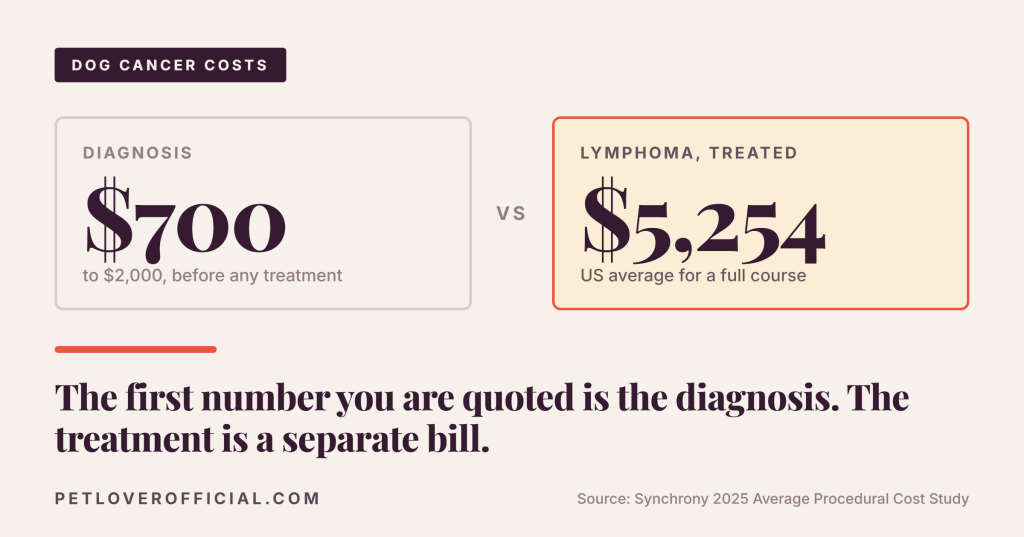
The number most owners are quoted first is the diagnosis, not the treatment — and the diagnosis alone runs $700 to $2,000 before anyone decides what to do. Synchrony’s 2025 cost study puts the national average for treating canine lymphoma at $5,254, and the range across the common cancers runs from about $2,500 to $27,000. Here is where each dollar goes, and which decisions actually move the total.
The short answer. For the most common canine cancer, lymphoma, Synchrony’s 2025 Average Procedural Cost Study puts the US average at $5,254 — from $4,231 in West Virginia to $9,387 in Hawaii. A full course of chemotherapy more generally runs $3,000 to $10,000 or more over several months. But cancer is not billed the way a fracture is. It arrives as a diagnostic workup, then a decision, then a course of appointments spread over four to six months, then rechecks that continue for as long as your dog is alive. The single biggest financial mistake is budgeting for the first bill instead of the sequence.
What each stage costs
Almost nobody pays one of these numbers. Most owners pay the diagnosis, then one or two of the treatment lines, then the rechecks.
| Stage | Typical US cost | What it is |
|---|---|---|
| Fine needle aspirate | $50 – $150 | The first test on a lump. Cheap, fast, and sometimes all you need to rule cancer in or out. |
| Biopsy and histopathology | $200 – $500 | Tissue sent to a pathologist. This is what names the cancer and grades it. |
| Oncology consultation | $125 – $500 | A specialist reads the file and sets out the options. Usually a separate fee from your regular vet, and higher at a referral hospital than a general practice. |
| Staging — bloodwork and imaging | $350 – $900 | Finding out whether it has spread. Bloodwork and X-rays or ultrasound. |
| CT scan | $800 – $2,500 | Needed before radiation, and before some surgeries. MRI runs higher again. |
| Surgical removal | From about $500 | Cornell puts major surgical procedures at roughly $500 upward. A straightforward skin mass sits near the bottom; an internal tumor needing a specialist runs into the thousands. |
| Chemotherapy, full course | $3,000 – $10,000+ | Four to six months. Per dose $150–$600, and the number of doses and your dog’s weight are what move the total. |
| Radiation, curative intent | $2,500 – $7,000 | Cornell’s own published range. Typically 15 to 20 sessions, each under anesthesia. |
| Radiation, palliative | $1,000 – $1,800 | Three to five sessions aimed at pain, not cure. A genuine option when cure is off the table. |
| Palliative and hospice care | $50 – $200 a month | Medication and comfort care, plus a recheck every two to four weeks at $100–$250. |
What the common cancers cost, start to finish
The name of the cancer decides almost everything about the bill, because it decides which treatments are on the table. These are full-course totals, not single procedures.
| Cancer | Full course | What treatment usually looks like |
|---|---|---|
| Lymphoma | $3,600 – $18,000 US average $5,254 |
Chemotherapy is the whole treatment — there is nothing to cut out. The standard CHOP-19 protocol runs 19 weeks, about 16 treatment visits. |
| Mast cell tumor | $2,700 – $18,000 | Surgery for low-grade tumors, often nothing more. High-grade means surgery plus chemotherapy, and sometimes radiation. |
| Mammary tumor | $2,550 – $13,600 | Surgery. Removing a single gland is far cheaper than removing the full chain. |
| Osteosarcoma | Commonly past $6,000 | Amputation or limb-sparing surgery, then carboplatin or doxorubicin chemotherapy. Palliative radiation is an alternative when surgery is declined. |
| Hemangiosarcoma | $5,400 – $27,000 | Usually presents as an emergency — a bleeding splenic tumor — so surgery happens before anyone has costed anything. Chemotherapy follows. |
Four things that move the number
Your dog’s weight
Chemotherapy is dosed by body surface area, so the drug cost for a Great Dane is a multiple of the same protocol for a terrier. It is the single most reliable predictor of where in the range you land, and the one thing you cannot negotiate.
Who delivers the treatment
A board-certified oncologist at a referral hospital costs more per visit than a general practice running a simple protocol. Some protocols genuinely need the specialist; some do not. It is a fair question to ask directly.
How much imaging is ordered
A CT scan can add $800 to $2,500 on its own. Before radiation it is not optional. In other situations it changes the plan only sometimes — worth asking what a given scan would rule in or out.
Where you live
In Synchrony’s 2025 study the average lymphoma course cost more than twice as much in Hawaii as in West Virginia. The same protocol, the same drugs, a different ZIP code.
The costs that arrive after the estimate
A surgical estimate covers the surgery. Almost everything below sits outside it, and together these are what turn a $4,000 plan into a $9,000 year.
Usually not in the first estimate
- Histopathology on whatever was removed
- Restaging scans every two to three months
- Bloodwork before each chemotherapy session
- Anti-nausea and appetite medication between visits
- Maintenance medication after the protocol ends
- The emergency visit when something goes wrong at 2am
Questions that change the total
- “What does this scan rule in or out, and what changes if we skip it?”
- “Is there a shorter protocol with a similar median survival?”
- “Can my regular vet deliver any of these sessions?”
- “What is the total across the whole protocol, including rechecks?”
- “If we treat for pain only, what does that cost and buy?”
Ask for the whole-protocol number, in writing. Veterinary estimates are usually written per procedure, because that is how the practice bills. An oncologist can almost always give you a figure for the full course if you ask for it specifically, and that number — not the first invoice — is the one to make the decision against.
What treatment actually achieves
Veterinary oncology is mostly not aiming at cure. It is aiming at more time at a good quality of life, and it is honest about that. Cornell states the goal of chemotherapy in pets plainly: to preserve the highest quality of life possible. Dogs generally tolerate chemotherapy far better than people do — the common side effects are reduced appetite, nausea, vomiting, diarrhea and dehydration, and doses are lowered or drugs dropped when they appear.
Knowing the numbers before you decide is worth more than any cost table.
| Situation | What the evidence shows |
|---|---|
| Osteosarcoma, amputation alone | Median survival three to four months |
| Osteosarcoma, amputation plus chemotherapy | Median 8 to 14 months depending on protocol; roughly 20–25% of dogs reach two years |
| Mast cell tumor, low grade | Average survival over two years, often with surgery alone |
| Mast cell tumor, high grade | Average survival under four months |
Two newer options worth asking about
Stelfonta (tigilanol tiglate) is an FDA-approved injection given directly into a mast cell tumor in the clinic, instead of surgery. The label covers non-metastatic cutaneous tumors anywhere on the body and non-metastatic subcutaneous tumors only at or below the elbow or hock, up to 10 cm³ — so it is not an option for every mast cell tumor. In the pivotal trial 75% of tumors had resolved completely by day 28, against 5.3% of untreated controls, and 89% of those dogs were still free of tumor at the treatment site a year later. The treatment leaves an open wound where the tumor was, which usually heals in four to six weeks, and prednisolone plus H1 and H2 blockers are mandatory alongside it to prevent a dangerous mast cell reaction.
Laverdia (verdinexor) is an oral tablet for canine lymphoma, given twice weekly at home at least 72 hours apart, with food. It held a conditional FDA approval for several years and received full approval in December 2025, announced in January 2026 — at which point it dropped the “-CA1” suffix that marked the conditional status. In the pivotal field study of 160 dogs, treated dogs went a median of 37 days before their disease progressed, against 23 days for controls. That is a modest gain rather than a substitute for chemotherapy, but it is a tablet rather than a course of infusions, which changes both the cost and the logistics for an owner who cannot reach a referral hospital every week.
What insurance pays — and the number that decides it
Cancer is covered by every major accident-and-illness policy we have reviewed, provided it was not pre-existing. That part is simple. The part that catches people is the annual limit.
A $5,000 annual limit does not cover a cancer. It covers the first half of one. A lymphoma course averages $5,254 nationally before diagnostics, and a large dog at a referral hospital goes well past that. For every other illness a mid-tier cap is defensible. For cancer it is the difference between a policy that works and a policy that runs out in March. If you are choosing a plan and cancer is what frightens you, buy the limit before you buy the reimbursement percentage — and see how the three numbers combine on a real claim.
Three policies with room for a five-figure year
Trupanion
No annual, per-condition or lifetime limit, and at participating hospitals it can pay the bill directly at checkout — which matters when the bill is $8,000. Two catches for a cancer claim: the illness wait is 30 days, the longest here, and exam fees are never covered, so every oncology recheck comes out of your pocket.
Get a quotePets Best
An unlimited annual option alongside a 70% reimbursement tier and deductibles to $1,000, so you can carry a high ceiling without a premium that climbs out of reach. Direct payment to the vet is available.
Get a quoteEmbrace
An unlimited annual option, three reimbursement rates at 70, 80 and 90%, and deductibles from $200 to $1,000 — useful if you want the high ceiling but need to pull other levers to afford it.
Get a quoteTwo further details decide whether a policy pays on a cancer claim.
The waiting period is doing more work than you think
A lump you noticed before the policy started is pre-existing, and no insurer in this market will cover it. A lump found during the 14 to 30 day illness wait is also excluded. Cancer is not something you can insure reactively — the date on the application is the whole product. More on that in our comparison of six insurers.
An older dog is where this decision is hardest
Almost half of dogs over ten develop cancer, which is exactly when a policy is most valuable and most expensive — and most likely to hit a pre-existing exclusion. We worked through that trade separately in pet insurance for older dogs.
On the “pre-existing conditions covered” pitch. AKC Pet Insurance advertises coverage for curable and incurable pre-existing conditions after 365 days of continuous enrollment, and 180 days for cruciate and IVDD. Read the qualifiers before you treat it as a cancer answer: AKC states the provision is not available in all states, its own examples of qualifying conditions are allergies, urinary tract infections, ear infections and gastrointestinal issues rather than cancer, and accident-and-illness enrollment is reported to close at nine years — younger than most dogs at diagnosis. A year is also longer than many aggressive cancers allow. We have not verified the provision against a policy document, and would not buy it on the strength of the marketing page alone.
How to pay for it without insurance
Ask about a clinical trial first
Veterinary teaching hospitals run oncology trials continuously, and enrolled dogs often receive treatment at reduced cost or free, with specialist monitoring included. Your oncologist will know what is recruiting. This is the single largest cost reduction available and it is routinely overlooked.
A teaching hospital, even outside a trial
University hospitals often price below private referral centers for the same specialist care, because residents and students are part of the model. The trade is scheduling and travel.
Financing, and what to watch in it
CareCredit is widely accepted, and its promotional periods are usually deferred-interest: clear the balance inside the window or interest can be charged back to day one. Scratchpay offers fixed installments with a soft credit check. Ask the practice about an in-house payment plan before either — it is almost always cheaper.
Grants exist, and they are small
Several US charities make grants toward veterinary cancer care. They are typically a few hundred dollars, they have waiting lists, and they will not fund a protocol on their own. Worth applying for; not worth planning around.
Palliative care is a legitimate choice, not a failure
Pain control and comfort care at $50 to $200 a month, with palliative radiation at $1,000 to $1,800 where it helps, is a real treatment plan with a real goal. For an older dog, or an aggressive cancer, or a household that cannot absorb $10,000, it is often the choice that puts the dog’s experience first.
What owners ask next
How much does it cost just to find out if it’s cancer?
A fine needle aspirate on a lump is $50 to $150 and often answers the question. If it doesn’t, a biopsy with histopathology is $200 to $500. A full workup — consult, biopsy, bloodwork and imaging to see whether it has spread — runs $700 to $2,000 before a single treatment decision is made. That figure surprises people more than the treatment cost does.
Is chemotherapy as hard on a dog as it is on a person?
No, and this is the most common misconception in the consulting room. Veterinary protocols use lower doses precisely because the goal is quality of life rather than cure at any cost. Cornell lists the common side effects as reduced appetite, nausea, vomiting, diarrhea and dehydration, and doses are reduced or drugs dropped when they show up. Most dogs continue to behave like themselves through treatment.
Does pet insurance cover cancer?
Yes, on any standard accident-and-illness policy we have reviewed, as long as no sign of it appeared before your coverage started or during the waiting period. Hereditary predisposition is not an exclusion — a Golden Retriever is not uninsurable for cancer. What decides whether the policy actually gets you through is the annual limit, which is why unlimited or near-unlimited tiers matter here more than anywhere else.
My dog was just diagnosed and has no insurance. Can I buy it now?
Not for this cancer. Every US insurer treats a diagnosis made before enrollment as pre-existing and excludes it permanently. A policy bought today would still cover unrelated future illness, which for a dog in treatment is not nothing — but it will pay nothing toward the cancer, and no waiting-period provision we know of changes that in a timeframe an aggressive cancer allows.
Is treating it always the right call?
No. Ask for the median survival with treatment and without it, for this cancer in this dog, and ask what the weeks in between will look like. For osteosarcoma, amputation alone gives a median of three to four months and amputation plus chemotherapy 8 to 14 months — a real difference, and one you can weigh. A high-grade mast cell tumor averages under four months even when treated. Those are different decisions, and only one of them is mostly about money.
Why is the price range on every estimate so wide?
Because dose scales with body weight, because a referral hospital and a general practice are not the same service, because the same course costs twice as much in one state as another, and because nobody knows at the start how many sessions your dog will need or how long they will live. The wide range is honest. What is not honest is an estimate that covers only the first procedure — ask for the whole-protocol figure.
How does this compare to other big vet bills?
Cancer sits at the top. A torn cruciate ligament is a $4,000 to $7,000 event that ends; cancer is a comparable figure that arrives in installments and does not. Looking at the largest claims insurers paid in 2025, the pattern holds — the biggest bills are illnesses, not injuries.
Budget for the course, not the consultation
Plan on $700 to $2,000 to find out what you are dealing with, and around $5,000 for a lymphoma course at the national average — with the aggressive cancers, the large dogs and the expensive states capable of running two to four times that. Ask your oncologist for one number covering the whole protocol, and ask what a clinical trial at the nearest teaching hospital would change.
If your dog does not have cancer today, the useful action is different and much cheaper: check the annual limit on your policy, or buy one with a ceiling that can absorb a five-figure year. Cancer is the diagnosis that finds the bottom of a mid-tier plan, and the only time to fix that is before the lump.
Compare six pet insurersRelated guides
Pet Insurance for Older Dogs: Is It Too Late?
Almost half of dogs over ten develop cancer, and that is the same age at which pre-existing exclusions start closing doors. What a senior policy still covers, and how to read the medical record before you buy.
Dog ACL Surgery Cost
The other big-ticket bill, and a useful contrast: a defined surgical event with a known total, rather than a course of treatment that stretches across a year.
How Pet Insurance Reimbursement Really Works
Deductible, then reimbursement rate, then annual limit. On a $9,000 cancer year the order of those three subtractions decides thousands of dollars.
Daisuke
Daisuke writes about pet insurance and the cost of veterinary care for petloverofficial.com. He builds each cost guide from veterinary teaching hospitals and published cost studies rather than marketing pages, cross-checks clinical figures against consensus guidelines and FDA approval documents, and says plainly when a number is an estimate rather than a quoted source.


Leave a Reply