The Year’s Biggest Vet Bills
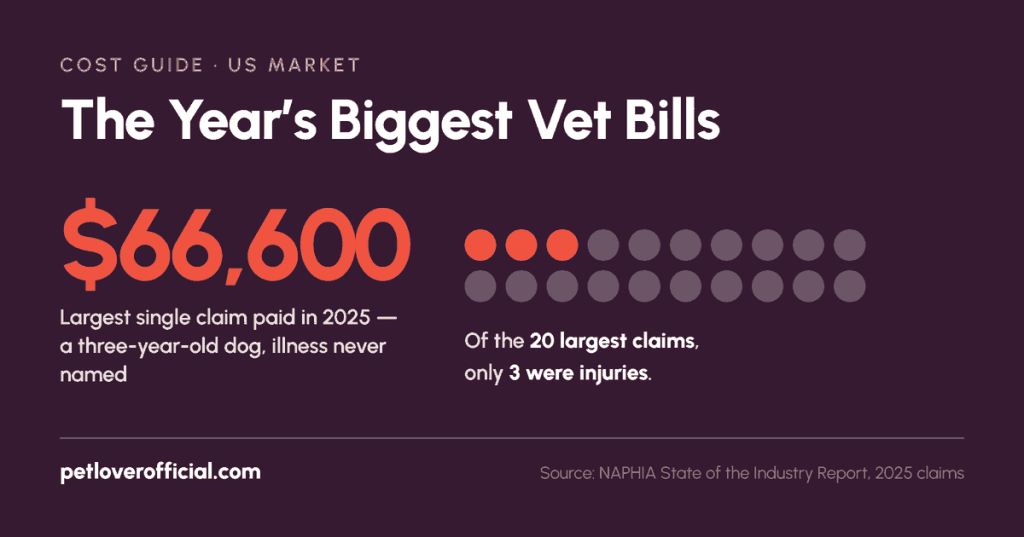
The largest claim NAPHIA’s member insurers reported paying last year was $66,600. It was not a car, a fight or a swallowed sock. It was a three-year-old Bernese Mountain Dog with an illness nobody could name. Across the twenty largest claims of 2025, only three were clearly injuries — and half the animals were seven or younger.
The short version. Almost everyone buys pet insurance picturing an accident. The claims data says accidents are not what empties the account. Of the twenty biggest claims paid across North America in 2025, at most four involved an injury; the rest were cancer, kidney disease, heart disease, liver disease and illnesses that were never given a name. Ten of the twenty animals were seven or younger. If you are budgeting for a broken leg, you are budgeting for the wrong thing.
The ten biggest dog claims of 2025
NAPHIA, the trade association most North American pet insurers belong to, publishes the largest single claims its member companies paid each year. This is not a survey or an estimate. It is money that actually left an insurer’s account.
| Paid | Dog | Age | Condition | Where |
|---|---|---|---|---|
| $66,600 | Bernese Mountain Dog | 3 | Undiagnosed illness, chronic | Philadelphia, PA |
| $60,100 | Small mixed breed | 10 | Undiagnosed liver disease | San Mateo, CA |
| $59,700 | Toy Poodle mix | 4 | Bite wounds | New Jersey |
| $56,700 | Medium mixed breed | 6 | Acute renal failure | Philadelphia, PA |
| $54,700 | Old English Sheepdog | 9 | Anemia | Brooklyn, NY |
| $46,700 | Medium mixed breed | 13 | Kidney disease | Mercer Island, WA |
| $43,600 | Jack Russell | 13 | Valvular heart disease | Middletown, DE |
| $43,400 | Greyhound | 10 | Wound | Chicago, IL |
| $42,600 | Cavalier King Charles Spaniel | 10 | Heart disease | Gainesville, FL |
| $42,300 | Shetland Sheepdog | 13 | Undiagnosed illness, acute | Garden City, ID |
The ten biggest cat claims of 2025
| Paid | Cat | Age | Condition | Where |
|---|---|---|---|---|
| $51,600 | American Shorthair | 4 | Cancer | Los Angeles, CA |
| $50,000 | Domestic Medium Hair | 3 | Corneal ulcer | Portland, OR |
| $45,900 | Mixed Medium Hair | 7 | Liver disease | Kirkland, WA |
| $37,400 | Domestic Medium Hair | 4 | Trauma | Kirkland, WA |
| $36,600 | American Longhair | 3 | Urinary system | Not disclosed |
| $35,900 | Bengal | 12 | Kidney disease | Union City, NJ |
| $31,900 | Domestic Shorthair | 11 | Pyelonephritis | Arizona |
| $26,400 | Ragdoll | 5 | Liver disease | Campbell, CA |
| $25,400 | Mixed Medium Hair | 6 | Pneumonia | Petaluma, CA |
| $24,500 | Mixed Domestic Shorthair | 13 | Azotemia | Los Angeles, CA |
Both tables are reproduced from NAPHIA’s State of the Industry Report published 21 June 2026, covering 2025 claims, rounded by NAPHIA to the nearest hundred dollars. The report states that these pages use member-contributed data only, so insurers outside NAPHIA are not represented. One thing worth noticing in the first column: NAPHIA publishes the amount paid out, not the amount billed. Each of these owners also paid a deductible and their share of the coinsurance, so the bill that arrived at the house was larger than the figure shown. We have glossed the clinical shorthand where it would otherwise be opaque — “hepatopathy” is liver disease, and “azotemia” is a build-up of waste products in the blood that usually points at the kidneys — and left the conditions themselves as published.
Three of the twenty were injuries
Read the condition column and the pattern is hard to miss. Two dogs were hurt — one bitten, one with a wound the report does not describe. One cat is listed simply as trauma. A fourth, the $50,000 corneal ulcer, could be either — a corneal ulcer can follow a scratch or an infection, and NAPHIA does not say which this was.
Everything else on both lists is illness. Cancer. Kidneys, twice on the dog list and three times on the cat list. Two hearts. Three livers. Anemia. Pneumonia. And three entries — the single largest claim of the year among them — where the insurer paid more than $42,000 for an illness that was never fully identified.
Why that last category matters. An undiagnosed illness is the most expensive kind, because the money goes on looking for the answer. Repeat imaging, referral specialists, biopsies, a second opinion, a third. A dog with a clear diagnosis has a treatment plan and a number attached to it. A dog without one has an open-ended investigation, and that is what $66,600 buys.
Half of them were seven or younger
The most common reason people give for not insuring a pet is that they will do it later, when the animal is older and the risk is real. Both tables argue against that, and the cat table argues against it emphatically.
10 of 20 were seven or under
Three dogs (aged 3, 4 and 6) and seven cats (aged 3, 3, 4, 4, 5, 6 and 7). That is exactly half the list, every one of them an animal most owners would still call young.
6 of 20 were four or younger
Including both species’ largest claims: the $66,600 Bernese was three, and the $51,600 cat with cancer was four.
Cats skew younger than dogs
Seven of the ten biggest feline claims were for cats aged seven or under. If you have been waiting for your cat to get old before insuring her, the data does not support the wait.
This matters more than it first appears, because of how pre-existing conditions work. Insuring a healthy three-year-old is cheap, and it covers whatever happens next. Insuring a nine-year-old who has already seen a vet about the thing that will eventually kill her buys coverage for everything except that. Nationwide says so plainly in its own press release: “It’s important to obtain coverage before your pet begins experiencing any symptoms because pre-existing conditions are excluded.”
The same pattern shows up in the ordinary claims
Extreme claims could be a quirk of the tail. They are not. In March 2026 Nationwide published its fifteenth annual analysis of what pets are actually treated for, built from more than 3.3 million claims submitted across more than a million insured dogs and cats in 2025. Its finding was the same one, from the other end of the distribution.
What Nationwide found in dogs
- Skin allergies ranked first for the fifteenth consecutive year
- Six of the top ten conditions are chronic — conditions that, in Nationwide’s words, “may require long-lasting care and follow families for years”
- No movement at all in the top nine, which the company reads as persistent, widespread patterns rather than noise
- Seizures entered the top ten for the first time, closely followed by kidney disease and cranial cruciate ligament tears
What it found in cats
- Digestive problems held the top spot for the third year running
- Seven of the top ten conditions are chronic, which Nationwide notes means “long-term costs can far exceed a single visit”
- The top six were unchanged from the previous year
- Reshuffling below that among inflammatory bowel disease, diabetes and respiratory infection — all three of them long-term problems
NAPHIA’s own list of the most commonly claimed conditions runs along the same lines: gastrointestinal problems lead for both species, followed by ear infections and skin conditions in dogs, and dental disease and urinary tract infections in cats. The only entry on either list that an accident would obviously explain is musculoskeletal, in dogs.
What a normal year actually looks like
It would be easy to leave the impression that a $50,000 bill is waiting for you. One almost certainly isn’t. These are the largest claims paid out of millions, which is precisely why they are published — they are the extreme tail, and most pets will never come close to one.
The ordinary numbers are these. NAPHIA puts the 2025 US average accident-and-illness premium at $836 a year for a dog and $435 for a cat. Against that, the events that do land on ordinary households sit in the low thousands: a torn cruciate ligament runs roughly $4,000 to $7,000 once diagnostics and aftercare are counted, a swallowed object and the surgery to retrieve it $2,000 to $10,000, a blocked male cat $1,500 to $3,500. Where you live moves all of those: the published state figures run about 2.2 times higher in Hawaii than in Mississippi, and the same factor applies to everything from a routine office visit to a course of cancer therapy.
So the honest framing is not “you will face $66,600.” It is this: the thing most likely to cost you four or five figures is an illness, it can arrive while your pet is young, and the bill is spread across months rather than delivered in one night. That is a different product from the one most people think they are shopping for.
And it is not a hypothetical for most owners. In the PetSmart Charities–Gallup State of Pet Care study of 2,498 US dog and cat owners, fielded between November 2024 and January 2025, 52% said they had skipped or declined veterinary care. Among those who did, 71% named cost as the key factor.
What this changes about what you buy
Accident-only is the wrong product
It is the cheapest tier on every quote screen, and against this data it is close to useless. At most four of the twenty biggest claims would have been eligible under it, and NAPHIA’s most-common-conditions list is almost entirely illness. Accident-only insures the thing that is least likely to ruin you. For cats in particular — not one injury appears anywhere on NAPHIA’s list of their most commonly claimed conditions — it is the wrong economy.
The annual limit is the number that matters
A $5,000 annual cap looks generous until you put it next to a $42,000 claim. All six insurers we track offer an unlimited tier, though Fetch sells its unlimited option only by phone. It is usually a modest step up in premium, and it is the single change that turns a policy from a rebate into real protection against the tail.
Chronic means it renews, and so does the deductible
An illness that runs for years crosses policy anniversaries. On most plans you pay the annual deductible again each year. Trupanion charges its deductible once per condition for the life of the policy instead, which is worth more on a long illness than on a one-off. How the deductible and the percentage combine decides what you actually get back.
The enrollment date beats every other decision
Nothing on this page is covered if it started before the policy did. That is the whole meaning of pre-existing, and it is why the age column in those tables is the most useful thing in this article.
Questions this raises
Would insurance actually have paid these?
These are claims that were paid, so in each of these twenty cases it did. What it would pay for you depends on three things in your own policy: whether the condition was pre-existing, whether your annual limit is high enough to reach the number, and your reimbursement rate. A 70% plan with a $10,000 cap facing a $42,000 bill pays $10,000, not $29,400.
Does a breed on this list mean my breed is risky?
No, and it would be a mistake to read it that way. Ten claims is far too small a sample to say anything about breed risk, and most of the entries are mixed breeds or ordinary domestic cats — which is what any large sample of insured pets would look like. The Cavalier King Charles Spaniel with heart disease fits a well-documented breed pattern; the Greyhound with a wound does not tell you anything about Greyhounds.
How can a claim be paid for an undiagnosed illness?
Insurers reimburse veterinary expenses, not diagnoses. Diagnostics, hospitalization and supportive treatment are covered whether or not anyone arrives at a name. That is also why these cases get expensive: without a diagnosis there is no point at which the investigation is obviously finished.
My pet is already eight. Is it too late?
Not formally — four of the six insurers we track set no upper age limit. But the medical file decides what a late policy is worth far more than the age does, and premiums climb steeply from around seven. We worked through the arithmetic in our guide to insuring an older dog.
What if I can’t pay a bill like this right now?
Ask the practice for an itemized estimate, then ask which lines on it can wait. Get a second estimate from a university teaching hospital if one is within reach, and ask about a payment plan before reaching for a medical credit card. We set out the full list of options, including grants and crowdfunding, in our cost guide to cruciate surgery.
Do these numbers mean premiums are about to rise?
Premiums have been rising: NAPHIA’s own figures put the average dog accident-and-illness premium up 11.5% in 2025 and 11.0% in 2024. Nothing in these tables changes that trend, and nothing in state law caps it — not one of the seventeen states with a pet insurance statute regulates price.
What we would do
Buy accident-and-illness coverage, not accident-only. Take the highest annual limit you will still pay for in three years, because the limit is what stands between you and the tail. And do it while the medical file is short — the age column on those two tables is the argument, not our opinion.
If you were about to buy the cheapest line on the quote screen because a broken leg is what you were picturing, that is the one decision this page exists to interrupt.
Compare the six insurers we track →Judged on reimbursement rate, deductible, annual limit and waiting period — the four numbers that decide what a claim actually pays out.
How we checked this
Both claims tables are reproduced from the NAPHIA State of the Industry Report published 21 June 2026, covering calendar year 2025, at Section 6. NAPHIA rounds the paid amounts to the nearest hundred dollars and marks these pages as member-contributed data only. The counts in this article — three injuries out of twenty, ten animals aged seven or under, six aged four or under — are ours, calculated from the published tables, and you can check them against the two tables above. We have treated the corneal ulcer as ambiguous rather than assigning it to either column.
The most-common-condition findings, the chronic-condition counts and the quotations are from Nationwide’s press release of 5 March 2026, which states that it analyzed more than 3.3 million claims submitted in 2025 from more than one million insured pets. Nationwide’s own cost figures are published as images in that release and we have not reproduced them, because we could not verify the numbers in text. The affordability figures are from the PetSmart Charities–Gallup State of Pet Care study of 2,498 US dog and cat owners, fielded 13 November 2024 to 9 January 2025.
Premium averages and the year-on-year increases are from the same NAPHIA report. The surgical cost ranges are the ones we compiled for our own cost guides, each of which lists its sources. The state-by-state cost factor is from our own analysis of CareCredit’s published figures, linked above. Where we could not verify a figure to a primary source, we left it out rather than estimate it.
About the author
Daisuke covers pet insurance and the cost of veterinary care for petloverofficial.com. He builds each comparison from insurers’ own policy documents and published claims data rather than their marketing pages, cross-checks against independent reviews where a company doesn’t publish a figure, and says plainly when a number is an estimate. He lives with a fifteen-year-old dog and three cats.


Leave a Reply