Pet Insurance Laws by State
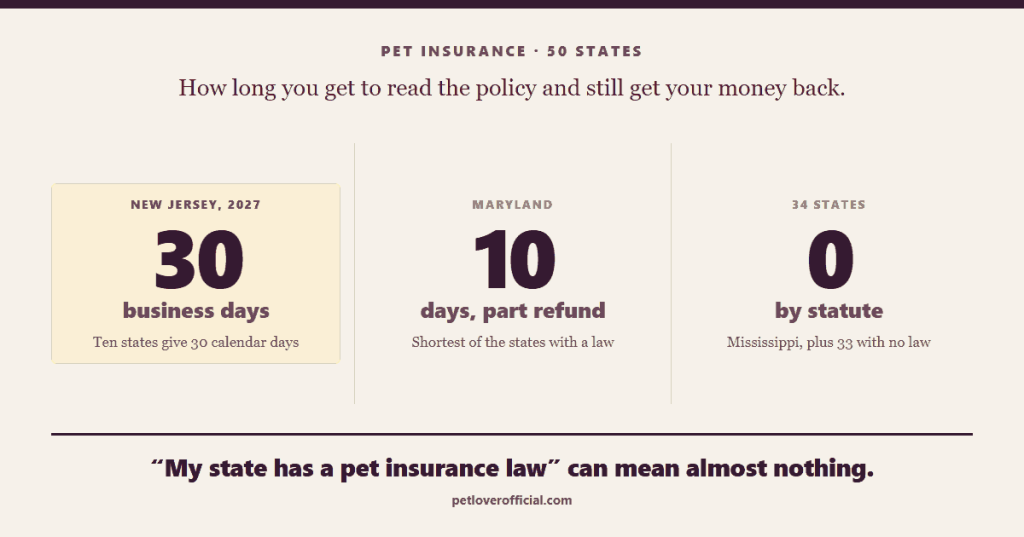
Seventeen states now have a pet insurance statute. Thirty-three and the District of Columbia have none at all. And “has a law” turns out to mean wildly different things: one state gives you six weeks to walk away from a policy, another gives you ten days and keeps part of your premium, and one gives you nothing beyond a list of definitions. Every figure on this page was read out of the statute itself.
The short version. If you live in California, Delaware, Florida, Hawaii, Nebraska, New Hampshire, Ohio, Pennsylvania or Vermont, you have 30 days to return a pet insurance policy for a full refund, and your insurer cannot make you wait to be covered for an accident. If you live in Maryland you get 10 days and a partial refund. If you live in Mississippi the statute gives you no return window at all. And in 33 states — including New York, Texas, Illinois and Massachusetts — no statute gives pet owners any of this, which means the only protection you have is the contract you signed. So the free-look clause in that contract is worth finding before you need it.
What your state gives you, in one table
All seventeen adopting states are below, sorted by the length of the free-look window — the period in which you can read the policy, change your mind, and get your money back. It is the single provision that varies most, and the one that is most useful to know in advance, because it is the only chance you get to read a pet insurance policy with the pressure off.
| State | Free look | Refund | Statute | In force since |
|---|---|---|---|---|
| New Jersey Longest | 30 business days | Full | N.J.S.A. 17:46D-7(b) | 1 January 2027 |
| California | 30 days | Full, plus any policy fee | Cal. Ins. Code §12880.2(j) | 1 January 2025 |
| Delaware | 30 days | Full | 18 Del. C. §8804(b) | 31 August 2023 |
| Florida | 30 days | Full | Fla. Stat. §627.71545(7) | 1 January 2026 |
| Hawaii | 30 days | Full | HRS §431:33-104(b) | 1 January 2026 |
| Nebraska | 30 days | Full | Neb. Rev. Stat. §44-6505(2) | 2023 |
| New Hampshire | 30 days | Full | N.H. RSA 402-P:3(II) | 1 January 2024 |
| Ohio | 30 days | Full | Ohio Rev. Code §3970.04(B) | 22 January 2025 |
| Pennsylvania | 30 days | Full | 40 Pa.C.S. §4704(a) | December 2024 |
| Vermont | 30 days | Full | 8 V.S.A. §7154(b) | 1 July 2025 |
| Louisiana | 15 days | Full | La. R.S. 22:1372(B) | 1 January 2024 |
| Maine | 15 days | Full | 24-A M.R.S. §3155(2) | 2022 |
| Montana | 15 days | Full | Mont. Code Ann. §33-24-404(2) | 2025 |
| Rhode Island | 15 days | Full | R.I. Gen. Laws §27-83-3(b) | 1 January 2026 |
| Washington | 15 days | Full | RCW 48.205.030(2) | 1 January 2024 |
| Maryland | 10 days | Pro rata only | Md. Code, Ins. §19-1104(b) | 1 January 2025 |
| Mississippi | None in the statute | — | Miss. Code §§83-87-1 to 83-87-9 | 1 July 2023 |
New Jersey’s window is 30 business days, which in practice is closer to six calendar weeks — the most generous in the country. It takes effect on 1 January 2027, twelve months after the act was approved on 12 January 2026. Maryland’s clause is not framed as a free look at all: the policy may be “surrendered to the insurer for cancellation” within 10 days, and what comes back is “a pro rata premium for the unexpired term,” not the whole payment.
“Adopted the model” does not mean “the same law”
All seventeen states appear in the same column of the NAIC’s chart — Model Adoption, meaning the state enacted the 2022 Pet Insurance Model Act “in a substantially similar manner.” Read the statutes side by side and that column hides an enormous range.
At one end is Vermont, which took the model and added four consumer protections that exist nowhere else. At the other is Mississippi, whose entire pet insurance chapter is five short sections: legislative findings, definitions, a list of things insurers must disclose, a note that licensed producers may sell the product, and a grant of rulemaking authority. It contains no free-look period. No cap on waiting periods. No ban on waiting periods for accidents. No requirement that a waiting period be waivable by a vet exam. No rule putting the burden of proof on the insurer. A Mississippi pet owner has the right to be told what the exclusions are, and that is essentially the list.
That gap matters more than the adoption count, so here is what each of the five substantive protections actually does, and who has it.
1. No waiting period for accidents
Your dog can be hit by a car on day one. Fourteen of the seventeen states say it flatly — “waiting periods for accidents are prohibited” — so accident cover has to be live as soon as the policy is. Maine and Maryland word it more narrowly, banning a waiting period only for an illness or orthopedic condition resulting from an accident, which leaves a theoretical gap for an injury that is neither. Mississippi has no rule at all, and nor does any of the 33 states without a statute, where whatever the contract says goes — accident waiting periods ranging from a few days to two weeks are still on sale.
2. A hard 30-day ceiling on illness and orthopedic waits
Sixteen states cap the illness waiting period, and the orthopedic one, at 30 days. This is the provision that ended the six-month knee-and-hip lockout: a policy sold in one of these states cannot make you wait half a year for cruciate ligament cover. Outside them, long orthopedic waits remain perfectly legal, and several insurers still use them.
3. The waiting period must be waivable by a vet exam
Sixteen states require the contract to contain a clause letting you shorten the waiting period to nothing by having your pet examined after you buy. You pay for the exam unless the policy says the insurer does. This is the most under-used right on the list, and the one worth acting on the week you enroll — see our insurer comparison for which companies publish the waiver procedure and which make you ask.
4. The insurer has to prove the condition was pre-existing
Sixteen states put it in writing, almost all of them in the model act’s own words: “the pet insurer has the burden of proving that the preexisting condition exclusion applies to the condition for which a claim is being made.” If a claim is denied as pre-existing, the company has to show why from the records — you are not the one who has to prove a negative. Absent a statute, that burden is a matter of contract and state common law, which is a far weaker place to argue from.
5. No vet exam as a condition of renewal
Sixteen states forbid making renewal conditional on a fresh examination, which stops an insurer from using the annual exam as a re-underwriting opportunity. A condition already covered also cannot be reclassified as pre-existing when the policy renews.
“Sixteen” in each case means all adopting states except Mississippi. New Jersey’s statute contains all five and takes effect in January 2027.
Vermont has the strongest pet insurance law in the country
This is not a close call, and it is not the state most people would guess. Vermont’s chapter took effect on 1 July 2025 and contains four provisions that no other state has enacted.
What only Vermont does
- The pre-existing lookback stops at 180 days. Everywhere else, “pre-existing condition” reaches back over your pet’s entire recorded history — a limp noted by a vet six years ago can still be used to deny a claim. Vermont defines it as a condition advised on, treated, or showing symptoms “within 180 days prior to the effective date” of the policy. Older history drops out of scope. 8 V.S.A. §7153(6)(A)
- You can change your deductible or limit without the policy being cancelled and reissued. That reissue is how coverage quietly resets elsewhere — a new policy can mean a new pre-existing date. §7155(g)
- A missed payment cannot suspend an open claim. “Coverage for new or existing claims shall not be suspended due to nonpayment of premium.” The policy stays in force until it is renewed, cancelled or non-renewed. §7155(h)
- Unpaid premium cannot be netted out of a claim payment. §7155(i)
Where it still leaves you exposed
- None of it changes the price. Vermont is a small market — roughly 0.3% of insured pets in the United States — and a smaller book means fewer plan choices on the quote screen, not cheaper ones.
- The 180-day lookback constrains how the insurer may define a pre-existing condition. It does not force cover for a condition that is genuinely active when you enroll.
- The statute applies to policies sold to Vermont residents. Moving to Vermont does not retroactively rewrite a policy bought elsewhere.
California and Rhode Island come next, and for a specific reason: both, along with Vermont and New Jersey, require coverage to be live by 12:01 a.m. on the second day after you pay. That closes a gap the model act left open, where an insurer could take your money and choose its own start date.
Maryland is the one adopting state where the law works against you
Two provisions are worth knowing before you buy in Maryland.
The first is the 10-day, pro-rata surrender window in §19-1104(b) — the shortest and the only partial one among the seventeen. The second is stranger. Section 19-1105(c) reads: “A pet insurer shall require that an insured submit a claim under the pet insurance policy after submitting payment to the veterinary practitioner for veterinary expenses.” Maryland has written the reimbursement model into its statute. The insurer is directed to require that you pay the vet first and claim afterwards.
If you have been shopping on the strength of a plan that pays the hospital directly at checkout, that is the provision to ask about before you enroll a Maryland pet. Maryland also goes further than the model in one direction worth crediting: §19-1104(a)(1) requires disclosure of all policy exclusions, not just the four categories the NAIC model names.
What to do about it: if paying the bill up front is the thing you cannot manage, the deciding factor is not the insurer’s marketing — it is whether your own hospital will bill an insurer at all, which is a question for the practice manager, not the insurance company. Our walk-through of how reimbursement is actually calculated shows what the cash-flow gap looks like on a real bill.
The 33 states with no pet insurance consumer-protection law
Not one of the five protections above exists by statute in: Alabama, Alaska, Arizona, Arkansas, Colorado, Connecticut, Georgia, Idaho, Illinois, Indiana, Iowa, Kansas, Kentucky, Massachusetts, Michigan, Minnesota, Missouri, Nevada, New Mexico, New York, North Carolina, North Dakota, Oklahoma, Oregon, South Carolina, South Dakota, Tennessee, Texas, Utah, Virginia, West Virginia, Wisconsin or Wyoming — or the District of Columbia.
That list includes New York, Texas, Illinois, Georgia, Michigan, North Carolina, Virginia, Massachusetts, Colorado and Arizona: between them, more than a third of every insured pet in the country.
Six of those states do have something on the books, and it is easy to mistake it for protection. The NAIC files them under Related Activity rather than adoption, and once you read the citations you can see why. Texas classifies pet insurance as inland marine for filing purposes. Idaho and Utah address which license lets an agent sell it. New Mexico lists it among the kinds of property insurance. Alaska issued a bulletin in 2016. Tennessee’s provisions date to 2008. These are filing and licensing rules written for insurers and agents. None of them gives a pet owner a free look, a waiting-period cap, or a burden-of-proof rule.
If you live in one of the 33, the practical position is this: your protections are exactly what your contract says, and nothing more. Three things are therefore worth doing before you pay.
Find the free-look clause in the contract
Most national insurers apply a 15- or 30-day money-back window everywhere they operate, because writing 50 versions of a policy is expensive. But without a statute it is a promise, not a right, and its length is theirs to set. Locate the clause, note the number of days and the date you received the documents, and treat that as your real deadline.
Read the waiting periods as a purchase decision, not a formality
Nothing stops an insurer from selling a six-month orthopedic wait in a state with no cap. For a large-breed puppy or any dog with knees in its future, that single number can matter more than the reimbursement rate.
Ask for the pre-existing definition in writing
Specifically: how far back does the insurer look, and what counts as a symptom? In 49 states the answer is effectively “as far back as the records go.” Getting the definition in writing before you enroll is what gives you something to hold the company to later.
What people in your state actually pay
Premiums are not set by state law — they are set by what veterinary care costs locally, and no insurer publishes a state-by-state rate table. But NAPHIA’s industry report does publish, for 2025, each state’s share of insured pets alongside its share of gross written premium. Divide one by the other and you get something genuinely useful: how much the average insured pet in that state costs to insure, relative to the national average.
For scale, the same report puts the 2025 US average accident-and-illness premium at $836 a year for a dog (about $70 a month) and $435 for a cat (about $36). The index below says how far a state sits above or below that.
| State | Share of US insured pets | Premium vs national average | Has a pet insurance law? |
|---|---|---|---|
| Massachusetts | 3.4% | About 18% above | No |
| Connecticut | 1.7% | About 18% above | No |
| California | 18.1% | About 10% above | Yes |
| Maryland | 2.1% | About 10% above | Yes |
| New York | 7.4% | About 9% above | No |
| New Jersey | 4.7% | About 9% above | From 2027 |
| Colorado | 3.0% | About 7% above | No |
| Illinois | 3.3% | About 6% above | No |
| Florida | 6.2% | About 5% above | Yes |
| Virginia | 3.0% | About 3% above | No |
| Pennsylvania | 4.5% | About 2% above | Yes |
| Washington | 3.8% | At the national average | Yes |
| Arizona | 2.1% | At the national average | No |
| North Carolina | 2.7% | About 7% below | No |
| Texas | 6.1% | About 8% below | No |
| Georgia | 2.3% | About 13% below | No |
| Michigan | 2.0% | About 15% below | No |
| Ohio Cheapest here | 2.6% | About 15% below | Yes |
Eighteen states, covering roughly 77% of every insured pet in the United States. We have deliberately left out the smaller states: NAPHIA rounds both shares to one decimal place, so for a state with 0.3% of pets the rounding alone can move the ratio by a third, and any figure we printed would be noise. Read the column as what owners in that state are paying — it reflects local vet prices, but also which breeds people insure there and how many buy wellness add-ons rather than bare accident-and-illness cover. It is not a quote, and it is not a like-for-like price comparison.
The pattern worth noticing: the column and the law have almost nothing to do with each other. Massachusetts and Connecticut are the most expensive states in the country to insure a pet and have no statute at all. Ohio is one of the cheapest and has one of the strongest. Consumer protection is not what you are paying for.
The three laws that changed in 2026
If you read an older state-by-state guide, three states have moved since.
Florida — Fla. Stat. §627.71545, in force 1 January 2026 (HB 655, ch. 2025-11). The third-largest pet insurance market in the country went from no statute to a full one, with a 30-day free look, the 30-day waiting-period cap, the accident-wait ban, burden of proof on the insurer, and mandatory agent training. Complaints route to the Department’s Division of Consumer Services, whose contact details now have to be handed to you with the policy.
Hawaii — HRS art. 431:33, in force 1 January 2026 (Act 79, signed 19 May 2025). Thirty-day free look. Act 79 also settled a classification oddity: Hawaii had been regulating pet insurance as marine and transportation insurance for want of a category, and now treats it as property insurance.
Rhode Island — R.I. Gen. Laws ch. 27-83, in force 1 January 2026. Fifteen-day free look, but with the newer coverage-start rule: live by 12:01 a.m. on the second calendar day after purchase.
And one more coming — New Jersey‘s act was approved on 12 January 2026 and takes effect on 1 January 2027, bringing the longest free look in the country at 30 business days. New Jersey is the fifth-largest market for insured pets, so this is the single biggest change on the horizon.
How to actually use a free look
The window is not there so you can change your mind about wanting insurance. It is there because a pet insurance policy is unreadable at the point of sale and perfectly readable a week later. Used properly, it is the most valuable thing on this page.
Day 1 — write down the date you received the documents
Every one of these statutes runs the clock from receipt of the policy, not from purchase. That is usually the email with the PDF attached. Keep it.
Day 1 — find the “Insurer Disclosure of Important Policy Provisions”
Sixteen of the seventeen states require the insurer to produce a document with exactly that title, summarizing every exclusion, waiting period, deductible, limit and claim-payment formula in one place, and to publish it behind a link on the main page of its website. It is the single most useful document in pet insurance and almost nobody reads it, because almost nobody knows it is required to exist. Ask for it by name.
Week 1 — book the exam that kills the waiting period
In sixteen states the contract must let you waive the waiting period by having your pet examined after purchase. Do it inside the free-look window, so that if the insurer’s requirements turn out to be unreasonable you can still walk away with your money.
Before the deadline — check the two numbers that decide payouts
Whether exam fees are covered, and whether the deductible comes off before or after the reimbursement percentage. Two policies quoting the same 80% and the same $500 deductible can pay out different amounts on the same bill. If it is wrong, cancel — you have not filed a claim, so the refund is unconditional.
One caveat that applies in every state: the right to a refund disappears the moment you file a claim. California is explicit that if the insurer has paid a claim, or has told you in writing that it will, the free look no longer applies and the ordinary cancellation terms take over. Read first, claim second.
Questions people actually ask
Does my state’s law follow me if I move?
Generally no. These statutes attach to policies sold, delivered or issued to a resident of that state — so they govern the policy you bought where you bought it. California goes furthest in the other direction: §12880.1 applies to any policy marketed, issued, amended or renewed to a California resident “whether or not in California,” regardless of where the contract was written. Moving into a state does not rewrite an existing policy. Moving out is worth a call to the insurer, not least because most policies reprice on geography.
My state has no law. Am I actually worse off?
In practice, less than the table suggests — most national insurers run one set of policy mechanics across the country and apply the strictest rule everywhere, because the alternative is 50 filings. What you lose is the floor. If a company decides to lengthen an orthopedic waiting period or reads the pre-existing definition aggressively, a statute is what you point at. Without one you are pointing at your contract, and hoping it says what you remember.
Is a 30-day free look really 30 days?
Thirty calendar days from receipt, in every state except New Jersey, where it will be 30 business days from 2027 — roughly six weeks. The refund itself is then due within 30 days of the insurer receiving the returned policy, which is a separate clock and a common source of confusion.
Do these laws cap what an insurer can charge?
No. Not one of the seventeen regulates price, and several explicitly permit premiums to rise with claim history, the pet’s age, or a change in your address. Pennsylvania’s contribution is to require that advertising say so: §4707 obliges an insurer to disclose in its ads whether it raises premiums or cuts coverage based on claim history, the species or breed, the pet’s age, or the insured moving.
What about the wellness plan the insurer sold me alongside the policy?
Wellness programs are not insurance, and most of these statutes now say so out loud: they cannot be marketed as insurance, cannot be required in order to buy a policy, and must be priced and documented separately. California is the strictest — §12880.8 requires a separate payment transaction, separate terms, and no duplication of what the policy already covers, and it treats anything described as a “wellness” benefit inside the policy as insurance. If you were sold both in one checkout in California, that is worth a question.
Where does this leave the pre-existing condition problem?
Mostly unsolved. Sixteen states shift the burden of proof onto the insurer, which is meaningful when a claim is disputed. Only Vermont limits how far back the insurer may look. Everywhere else, the honest answer is that the best protection is still to enroll before there is anything to find — which is why the age and history questions in our guide to insuring an older dog matter more than any statute on this page.
What we would do
Look up your state in the first table, note the number of days, and then go and buy on the merits of the policy rather than the merits of the legislature. The law sets a floor; it does not pick a plan. Reimbursement rate, deductible, annual limit and waiting period still decide what a claim pays, and those are contract terms in all 50 states.
Then use the window. Whatever your state gives you — 30 days, 15, 10, or only what the contract promises — the period after you buy and before you claim is the one chance you get to read a pet insurance policy properly. It costs nothing and it is the only part of this process where the pressure is off.
Compare the six insurers we track →Six plans, judged on the four numbers that decide what a claim actually pays out.
How we checked this
The list of which states have adopted the NAIC Pet Insurance Model Act comes from the NAIC’s own state page for Model #633, Summer 2026 edition, which places seventeen states in Model Adoption and six in Related Activity. We then read the statute itself for every one of the seventeen, on the state’s own legislative site wherever it was reachable: California (leginfo.legislature.ca.gov), Florida (flsenate.gov), Delaware (delcode.delaware.gov), Maryland (mgaleg.maryland.gov), Washington (app.leg.wa.gov), Ohio (codes.ohio.gov), Nebraska (nebraskalegislature.gov), Maine (legislature.maine.gov), Louisiana (legis.la.gov), Vermont (legislature.vermont.gov), Pennsylvania (palegis.us), New Hampshire (gencourt.state.nh.us), Hawaii (capitol.hawaii.gov), Montana (legmt.gov), Rhode Island (rilegislature.gov) and New Jersey (the session law, P.L. 2025 c. 224, at njleg.state.nj.us). Mississippi’s chapter was read from a published text of Miss. Code §§83-87-1 to 83-87-9.
Two corrections to the NAIC chart, for anyone following the citations: it lists California as §§12880.0 to 12880.6, but the chapter runs to §12880.8, and §§12880.7 and 12880.8 — added by SB 1217 in 2024 — are where the waiting-period and wellness rules actually live. It lists New Jersey as §§17:46D-3 to 17:46D-8; the session law codifies 17:46D-3 through 17:46D-11.
Premium figures and state market shares are from NAPHIA’s State of the Industry Report published 21 June 2026, covering calendar year 2025. The relative-premium column is our own calculation from the two published shares, not a NAPHIA figure, and its limits are described under the table. Where we could not verify something to a primary source, we left it out rather than round it.
Nothing on this page is legal advice, and a statute can be amended between our update date and your reading it. If a specific denial or refund is at stake, the citations are there so you can check the current text, and your state insurance department is the place to complain.
About the author
Daisuke covers pet insurance and pet tech for petloverofficial.com. He builds each comparison from insurers’ own policy documents and help pages rather than their marketing pages, cross-checks against independent reviews where an insurer doesn’t publish a figure, and says plainly when a number is an estimate. He lives with a fifteen-year-old dog and three cats, which is how most of these questions come up.
Related guides:
- Pet Insurance Waiting Periods by State — the same statutes, read for one thing: what they do to the waiting period in the policy you actually receive. In sixteen states the filed contract is shorter than the insurer’s website, and we read nineteen policy booklets to show it.
- Does Pet Insurance Cover Pre-Existing Conditions? — where the model act’s three-prong definition and its burden-of-proof provision actually bite, and the one state that limits how far back an insurer may look.


Leave a Reply