Pet Insurance Waiting Periods by State
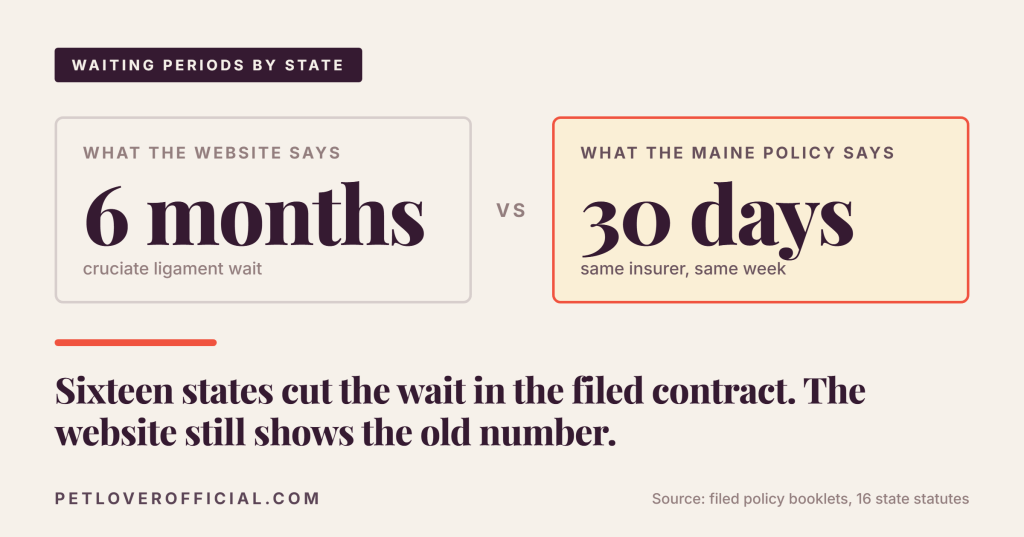
In sixteen states, the waiting period written into the policy you actually buy is shorter than the one on the insurer’s website — in one case by five months. The change is in the filed contract, not the marketing page, and almost nothing tells you it applies to you.
The short version. Pets Best advertises a six-month waiting period for cruciate ligament problems. In Maine, the policy it actually files says thirty days, and the three-day waiting period for injuries is deleted outright. The same thing happens in fifteen other states. It happens because those states passed a law, and the law reaches into the contract whether or not the website mentions it. If you live in one of them, the number on the comparison page you are reading is not your number.
One booklet, two different sets of waiting periods
Pets Best publishes its policy booklets as PDFs, one per state. Open the Maine booklet and the standard terms are near the front: a 14-day wait for illnesses, a 3-day wait for injuries, and a six-month wait for cruciate ligament events. Keep reading and there is a Maine Amendatory Endorsement, form APIC-PBI0004-AE-ILL-ME (11/2022), which begins:
“Paragraph C. of section 2. POLICY BENEFITS IN DETAIL is deleted in its entirety and replaced by the following: A. WAITING PERIODS: 1. 14 days following the Policy Effective Date for any Illnesses and any related Conditions. 2. 30 days following the Policy Effective Date for any Cruciate Ligament Events and any related Conditions.”
Two things changed. The cruciate ligament wait fell from six months to thirty days. And the three-day waiting period for injuries is simply not in the replacement list — the paragraph is gone.
| Pets Best | Standard policy | What the Maine endorsement says |
|---|---|---|
| Illness | 14 days | 14 days |
| Injury | 3 days | No waiting period |
| Cruciate ligament | 6 months | 30 days |
The sixteen states where your policy is different
We pulled the Pets Best booklet for all seventeen states that have passed a pet insurance statute, plus Texas and Georgia, which have not. Sixteen booklets carry the same replacement clause. Three do not.
| State | Statute section we read | Cruciate wait in the filed policy | Injury wait |
|---|---|---|---|
| California | Ins. Code §12880.7 | 30 days | None |
| Delaware | 18 Del. C. §8805(b) | 30 days | None |
| Florida | Fla. Stat. §627.71545(9)(b) | 30 days | None |
| Hawaii | HRS §431:33-105 | 30 days | None |
| Louisiana | La. R.S. 22:1373 | 30 days | None |
| Maine | 24-A M.R.S. §3156(2) | 30 days | None |
| Maryland | Md. Code Ins. §19-1105 | 30 days | None |
| Mississippi | No policy-conditions section | 30 days | None |
| Montana | Mont. Code §33-24-405 | 30 days | None |
| Nebraska | Neb. Rev. Stat. §44-6506 | 30 days | None |
| New Hampshire | N.H. RSA 402-P:4 | 30 days | None |
| Ohio | Ohio Rev. Code §3970.05 | 30 days | None |
| Pennsylvania | 40 Pa.C.S. §4706 | 30 days | None |
| Rhode Island | R.I. Gen. Laws §27-83-4 | 30 days | None |
| Vermont | 8 V.S.A. §7155(b) | 30 days | None |
| Washington | RCW 48.205.050(2) | 30 days | None |
| New Jersey | Statute passed, in force 1 January 2027 | 6 months | 3 days |
| Texas control | No pet insurance statute | 6 months | 3 days |
| Georgia control | No pet insurance statute | 6 months | 3 days |
New Jersey is the useful one. It passed a statute, so it belongs on the list of states with a pet insurance law — but the law does not take effect until 1 January 2027, and New Jersey is the only state on that list whose policy booklet still carries the six-month wait and the three-day injury wait. The switch has not been thrown yet. You can watch the law working by looking at the one place it has not reached.
WhyWhat these laws actually say
Sixteen states now have a section, usually headed “Policy conditions,” that does four things. We read all sixteen. The wording is close to identical in most of them:
1. Thirty days is the ceiling
A waiting period “may not exceed 30 days for illnesses or orthopedic conditions not resulting from an accident.” Every one of the sixteen has this. It is the provision that turns a six-month cruciate wait into a thirty-day one.
2. Accidents get no waiting period at all
Thirteen of the sixteen say it flatly: “Waiting periods for accidents are prohibited.” This is the provision that deletes the three-day injury wait.
3. An exam has to be able to waive it
Every one of the sixteen requires the insurer to put a clause in the contract allowing the waiting period to be waived once a veterinarian examines your pet. Where this exists it is a right, not a courtesy, and several states add that the insurer may not “unreasonably restrict” your ability to use it. You normally pay for the exam.
4. Renewal does not restart it
Two drafting styles here. Some states say a waiting period “shall not be applied to a renewal of existing coverage.” Others say the insurer may not require a veterinary examination as a condition of renewal. The effect is the same: you serve the wait once.
Two states word it more narrowly, and one has no rule at all
Reading all sixteen rather than assuming they match turned up real differences on the accident point.
| Drafting | States | What it says |
|---|---|---|
| Flat prohibition | CA, DE, FL, HI, LA, MT, NE, NH, OH, PA, RI, VT, WA | “Waiting periods for accidents are prohibited.” |
| Narrower | Maine, Maryland | Prohibits a waiting period only for an illness or orthopedic condition resulting from an accident — not, on its face, for an accident claim itself. |
| Nothing | Mississippi | There is no policy-conditions section. §83-87-5 is disclosures, §83-87-7 is producer licensing, and §83-87-9 only lets the commissioner write rules about policy conditions. The statute itself sets no cap and no accident rule. |
Three of them also fix the hour. A ban on accident waiting periods still leaves the insurer choosing when the policy starts. California (§12880.7(b)(4)(A)), Vermont (§7155(b)) and Rhode Island (§27-83-4) each close that by requiring coverage to be live no later than 12:01 a.m. on the second day after you pay — California adds that the effective date and time must be prominently disclosed. Delaware and Florida, which we checked for comparison, have no equivalent rule, so in those states the start time is whatever the contract says.
Mississippi is worth pausing on. It is counted among the states with a pet insurance law, and it has one — but its law does not cap waiting periods. Pets Best files the thirty-day endorsement in Mississippi anyway, the same one it files in states that require it. The likely explanation is that insurers draft one form for “model act states” rather than tailoring to each. If that is right, a Mississippi owner currently gets a protection the legislature never voted for, and could lose it without any change in the law.
The companiesSix insurers, three different ways of handling the same law
| Insurer | Accident | Illness | Orthopedic / cruciate | Does it publish the state difference? |
|---|---|---|---|---|
| Pets Best | 3 days | 14 days | 6 months | Yes — a filed endorsement per state, with the booklets public |
| Embrace | — | 14 days | 180-day exclusion | Yes — a state selector naming which states get 30 days |
| Fetch | None — day one | 15 days | 180-day exclusionary period | Partly — state resident notices exist, but the waiting period FAQ does not mention them |
| ASPCA | 14 days | 14 days | 12 months on some forms, 14 days on others | Partly — a California notice exists |
| Pumpkin | 14 days | 14 days | None — same 14 days as everything else | Partly — a Washington notice exists |
| Trupanion | 5 days | 30 days | No separate period stated | Partly — a California notice, dated by policy version |
The most useful line in that table has nothing to do with state law. A six-month wait for knees and hips is not an industry standard — it is a choice. Pumpkin covers cruciate ligaments, IVDD and hip dysplasia after the same fourteen days as everything else, everywhere. Trupanion’s California notice states a five-day accident wait and a thirty-day illness wait and sets out no separate orthopedic period at all, though we could not load its main waiting-period page to confirm that nationally. If cruciate disease is the specific thing you are insuring against, and it is one of the most common expensive problems in dogs, that single fact matters more than any state statute. We costed the surgery itself in dog ACL surgery cost.
How Fetch’s Vermont notice reads
Fetch publishes a 15-day waiting period for illness, accident coverage from day one, and a 180-day exclusionary period for orthopedic conditions. Its Vermont residents notice says something different: “There is a thirty (30) day period beginning on the effective date of this policy during which we will not cover any orthopedic condition not resulting from an injury or accident.” The same notice defines a pre-existing condition as one arising “up to 180 days prior to the original inception date” — Vermont’s statutory limit on how far back an insurer may look, which no other state imposes.
How Embrace publishes it
Embrace has built a page that routes all fifty states and the District of Columbia to one of three sets of terms. Six states — California, Louisiana, New Hampshire, Pennsylvania, Vermont and Washington — get a thirty-day exclusion period for the four named orthopedic conditions. Forty jurisdictions get a 180-day version of the same clause. Whatever else is true, Embrace is the only one of the six that lets you look your state up in one click.
UnresolvedA waiting period, or an exclusion period?
Here is the part we cannot settle, and we would rather say so than pretend otherwise.
Embrace and Fetch both describe their orthopedic window as an exclusion period or a pre-existing condition, not as a waiting period. That distinction could matter a great deal, because the statutes cap “waiting periods.” If a 180-day exclusion is not a waiting period, the cap may not reach it.
Except that the industry’s own practice cuts against that reading. All three of the companies with a long orthopedic window — Pets Best, Embrace and Fetch — shorten it to thirty days in at least some of these states. Whatever they call it, they treat it as something the statutes reach.
What we could not explain is why Embrace draws the line where it does. Delaware is on its 180-day page. Delaware’s statute caps waiting periods at thirty days (18 Del. C. §8805(b)) and defines a pre-existing condition as one arising “prior to the effective date of a pet insurance policy or during a waiting period” (§8803(a)(6)) — the same two-part structure as California, which is on the thirty-day page. Florida and Maryland are in the same position.
We asked Embrace. On 6 October 2026 we wrote to Embrace’s press office setting out exactly what is above and offering four ordinary explanations: that the policy form filed in those states differs from the public page; that the regulators there have accepted the exclusion-period distinction; that the page is out of date; or something we had not thought of. This paragraph will be replaced with their answer in full when it arrives. We are not alleging that any company has broken any law. We have not read the policy form filed in Delaware, and until someone does, the honest position is that we have a question, not a finding.
Thirty days is shorter. It is not automatically kinder.
It is tempting to read this as thirty days good, six months bad. Read Embrace’s thirty-day page closely and the trade shows up: the four orthopedic conditions that “occur or show Clinical Signs during the first thirty (30) days after the Pet Original Start Date are excluded and are Preexisting condition for the life of the policy.”
A shorter window with a permanent consequence is still a permanent consequence. If your dog’s knee gives out in week three in California, that knee — and, at several insurers, the other one too — is excluded for as long as you hold the policy. The law shortened the window. It did not change what happens inside it. We went through that mechanism in detail in does pet insurance cover pre-existing conditions.
PracticalWhat to do with this before you buy
Worth doing
- Ask for the amendatory endorsement filed in your state, by name. It is a specific document and the insurer has it.
- Read the Declarations Page, which states the waiting periods that apply to your policy, rather than the comparison table on the website.
- If you are in one of the sixteen states, ask whether the exam waiver applies to you — it is in the statute, and it can remove the wait entirely.
- If knees are your worry, compare insurers on the orthopedic wait specifically. Two of the six do not impose one.
Not worth doing
- Assuming the number on a comparison site is your number. Most of them publish one figure for all fifty states.
- Moving to a new insurer to escape a wait. You restart every waiting period, and the new insurer reads the same medical records.
- Treating a short waiting period as the main thing. The annual limit and the reimbursement rate decide far more of what a claim pays — see our six-insurer comparison.
What owners ask about this
Does my state cap pet insurance waiting periods?
Sixteen do, as of October 2026: California, Delaware, Florida, Hawaii, Louisiana, Maine, Maryland, Montana, Nebraska, New Hampshire, Ohio, Pennsylvania, Rhode Island, Vermont and Washington cap them at thirty days for illness and orthopedic conditions, and Mississippi has a pet insurance statute that does not set a cap. New Jersey’s law arrives on 1 January 2027. Everywhere else, the contract decides. The wider picture is in pet insurance laws by state.
Why does the website say six months if my policy says thirty days?
Because the website is usually written once for the whole country and the policy is filed state by state. The state-specific document is called an amendatory endorsement, and it overrides the standard terms where the two conflict. It is not hidden — Pets Best publishes every state’s booklet — but nothing on a comparison page points you to it.
What is an amendatory endorsement?
A page attached to the policy that changes specific paragraphs to comply with the law of one state. The Maine one quoted above deletes the standard waiting period paragraph and replaces it. If you want to know what you are actually buying, this is the document to ask for.
Does the cap apply to a policy I already have?
These provisions generally attach to policies issued or renewed after the law takes effect, so an older policy may still carry the longer wait until it renews. Ask your insurer which form version your policy is on — at least one insurer publishes separate disclosures for policies enrolled before and after a particular date.
Is a shorter waiting period always better?
Not by itself. In the thirty-day states, a condition that shows clinical signs inside the window becomes a pre-existing condition for the life of the policy. A shorter window is better only in the sense that there is less time for that to happen. The honest version of the advice has not changed: buy while there is nothing to claim.
Which insurer has no orthopedic waiting period at all?
Of the six we track, Pumpkin applies the same fourteen days to cruciate ligaments, IVDD and hip dysplasia as to everything else. Trupanion’s California notice sets out no separate orthopedic period either, although we were unable to load its main waiting-period page and have not confirmed that for every state. Both are worth pricing if orthopedic cover is the reason you are buying — and worth asking the question directly before you do.
The law is working. Nobody is telling you.
This research started out expecting to find insurers advertising waiting periods longer than the law allows. That is not what is happening. In sixteen states the companies have filed shorter terms, quietly and correctly, and the protection is sitting in the contract waiting to be used.
What is missing is the last step. A buyer in Maine reads “six months for cruciate ligaments,” decides the cover is not worth it for an older dog, and closes the tab — when the policy on offer would have covered that knee after thirty days. The information exists. It is in a PDF behind a link that nobody clicks.
Compare six pet insurersDaisuke
Daisuke writes about pet insurance and the cost of veterinary care for petloverofficial.com. He builds each guide from statutes and filed policy documents rather than marketing pages, and says plainly when a question is still open.

