
Fresh Dog Food Subscriptions: How to Pick the Right One for Your Dog
Five subscription services, compared on the things that change your day-to-day life: how the food is stored, how it’s formulated, how much it costs to feed, and whether your dog will eat it.
Specs last verified: September 2026. Recipes, pricing, and shipping details in this category change often, so confirm current pricing on the brand’s own site before you subscribe. Every figure we could verify was checked against the manufacturer’s own site, help center, or its own signup quiz. Where a brand’s own pages don’t state a figure, we say so (marked Not stated in the table) rather than copying a number from a third-party site. Read those as unknown, not as an implied answer.
Affiliate disclosure: This post may contain affiliate links. If you buy through one of them, we may earn a commission at no extra cost to you. That commission does not change which services we cover or how we describe them, and none of the brands here reviewed or approved this article before publication. This guide is general information for dog owners, not veterinary advice — diet changes for a puppy, a senior dog, or a dog with a diagnosed condition should go through your own veterinarian. Product names and logos are the property of their respective owners, and we are not affiliated with these companies beyond the affiliate relationships disclosed above. The five-bar scores are our own assessment of what each brand publishes, not results from hands-on testing.
Three picks, three different kitchens
Spot & Tango (UnKibble)
A shelf-stable “Fresh Dry” format that sits in the pantry instead of the freezer. The default choice if you have no appliance space to spare, or you travel with your dog.
Check current pricingSundays for Dogs
Air-dried, closer in texture to a dense kibble than anything else here. Buy this if your dog is transitioning off kibble and you want the smallest possible jump in texture.
Check current pricingNom Nom
Names a board-certified veterinary nutritionist directly on its own site, and is also stocked by Chewy, PetSmart and Amazon if a subscription ever lapses.
Check current pricingThe Farmer’s Dog is covered in full below, but we’re still not naming it a pick here. A manual pass through its public pages and a sample run through its own quiz confirmed: human-grade and AAFCO-feeding-trial claims, a direct-to-consumer retail model, individually pre-portioned meals, and a real per-day price example. What’s still missing is its total recipe catalog and its transition and multi-dog policies. It’s close enough that it may well earn a pick once those last few details check out.
Why “Fresh” Dog Food Even Needs a Buying Guide
If you’ve ever stood in the pet food aisle reading ingredient lists you can’t pronounce, you already understand the appeal of fresh dog food. The pitch is simple: real, recognizable ingredients, portioned for your specific dog, delivered to your door instead of sitting on a warehouse shelf for months.
What the pitch doesn’t tell you is that “fresh dog food” covers several different formats wearing the same marketing language. Some of these services ship food that lives in your freezer. Some ship food that goes straight in the fridge. At least one ships food that needs no refrigeration at all. That difference sounds minor until it’s dinnertime and your freezer is full, or until you’re packing a week of meals for a trip to your in-laws’.
So this guide skips the exercise of crowning one “best” fresh dog food. Instead it gives you a framework that holds up no matter which brands happen to be running promotions when you read it, then applies that framework to five services on the market so you can see how it plays out.
My own dog is the reason I stopped assuming “healthier food” and “food my dog will eat” were the same thing. He’s a senior rescue who went through a rough patch of turning his nose up at meals entirely. No interest in his usual kibble, and, it turned out, just as little interest in the frozen fresh food I tried first, even after thawing and warming it. Our vet’s main concern at that point wasn’t the ingredient list; it was that he simply wasn’t eating enough. It took switching to a dry, shelf-stable format, one that looked and crumbled more like the kibble he already knew, before he’d reliably clean his bowl again. Nothing about his diagnosis changed. The format did.
That’s one dog, and one dog is an anecdote rather than evidence. Your picky eater might go the other direction and hold out for something wetter. The transferable part isn’t “buy the shelf-stable one,” it’s that texture and format deserve a real place in your decision instead of a footnote, which is why they get their own section below.
A note on “human-grade.” Several brands in this category use the term “human-grade” on their marketing pages. AAFCO, the association that publishes the model pet food regulations U.S. states draw on, calls it “a marketing term that has specific guidelines set forth by AAFCO,” and says its human grade standard is written to “outline how all human grade pet food products should be manufactured in accordance with the acceptable regulations for ready-to-eat human food.” Read that carefully and it’s a claim about how and where the food is made, not only about ingredient quality.
Of the five services here, Ollie, Spot & Tango, Sundays and The Farmer’s Dog all use the term on their own sites. Ollie is specific about it, saying its recipes are “cooked in licensed, human-grade facilities” that “meet or exceed all FDA and USDA standards for human-grade food manufacturing, including USDA Process Verified certification.” The Farmer’s Dog leans on the term harder than any other brand here: its homepage title is literally “Human-Grade Fresh Dog Food Delivery,” its meta description promises “100% human-grade food,” and its FAQ states plainly that “our food is made to human-grade safety and quality standards,” with its Instant Fresh line carrying the same claim. Its veterinary-facing portal explains the term as covering both the ingredients and the manufacturing facility meeting the same FDA-based safety and quality standards as food made for people, while adding an important caveat of its own: the claim describes how the food is made, not a suggestion that it’s nutritionally interchangeable with something a person would eat, since dogs and people have different nutritional needs. Nom Nom’s own pages describe “real, whole food ingredients” without using the human-grade phrase at all. Treat the label as one data point rather than a synonym for “better.”
Six Questions to Ask Before You Compare Brands
Before comparing specific brands, it helps to have a framework that stays useful no matter which promotions are running when you’re reading this. These are the six questions that matter most.
1. What format does the food ship in, and where does it live in your kitchen?
This is the question most comparison articles skip, and it’s the one that determines whether a subscription survives contact with your real life. Broadly, fresh dog food services ship in one of four formats:
Fresh, refrigerated: arrives ready or near-ready to serve, needs fridge space, generally has the shortest shelf life once opened. Fresh, frozen: arrives frozen, needs freezer space, needs thawing time before serving. Fresh-dried / “fresh-dry”: ingredients are gently dried rather than frozen; shelf-stable at room temperature. Air-dried: similar shelf-stability to fresh-dried, with a different dehydration process and a texture closer to a dense kibble.
None of these is universally “more fresh” than the others. They’re different preservation methods with different tradeoffs. A frozen format may hold on to more of a raw-adjacent texture, while a shelf-stable format trades some of that away in exchange for freezer space, lighter shipping and easier travel. Work out which tradeoff fits your kitchen before you fall for a specific brand’s photography.
2. Is it formulated to be complete and balanced for your dog’s life stage?
In the U.S., “complete and balanced” is a regulated claim, and a brand generally supports it one of two ways: by formulating to AAFCO nutrient profiles, or by running AAFCO feeding trials.
Four of the five services here state their formulation route on their own sites, and all four state all life stages. Ollie: “all of our recipes are formulated to meet AAFCO guidelines for all life stages.” Nom Nom: recipes “meet standards set by AAFCO’s Dog Food Nutrient Profiles for all life stages.” Spot & Tango: “all of our recipes meet or exceed the AAFCO Nutrient Profiles for all life stages, including growth of large size dogs (>70 pounds or more as an adult).” Sundays prints the full statement on each recipe page — the Fish recipe “is formulated to meet the nutritional levels established by the AAFCO Dog Food Nutrient Profiles for All Life Stages, including growth of large size dogs (70lb. or more as an adult),” and the brand’s own WSAVA page confirms this is by formulation rather than feeding trials. The Farmer’s Dog states both routes at once: general pages call its recipes “AAFCO Complete & Balanced” with nutrition that “exceeds industry standards (AAFCO),” while its veterinary portal goes further, stating recipes are “Backed by AAFCO Feeding Trial & meets WSAVA guidelines” and describing board-certified nutritionists designing to AAFCO profiles, verified through multi-year feeding trials plus third-party palatability and digestibility research. Life-stage marketing mentions puppy, adult and senior plans, but the exact AAFCO life-stage statement isn’t shown on its public pages.
One distinction is worth keeping straight. Nom Nom does say it “backs up all of our products with feeding studies,” but describes those studies as testing “palatability and digestibility standards,” which is a different thing from an AAFCO feeding trial. All of this matters more for long-term daily feeding than for an occasional topper, and it matters most if your dog is a puppy, a senior, or managing a diagnosed condition. In those cases, talk to your vet before you switch rather than after.
3. Does the lineup work for a dog with food sensitivities?
If you landed here because your dog itches, scratches, or has an unpredictable stomach, this is the question that matters most to you, and it’s the one brand marketing is vaguest about. Three things are worth keeping straight.
First, none of the five services here sells a prescription or therapeutic diet, and two say so outright. Nom Nom states it doesn’t “currently offer prescription diets for dogs.” Sundays says it “is not intended to replace a prescription food.” A true food-allergy workup is a vet-directed elimination trial, and a retail subscription plan is not a substitute for that process.
Second, if you’re avoiding one specific protein rather than trying to identify it, count the recipes before you subscribe, because the lineups are smaller than the marketing suggests. Among the four we could verify, Nom Nom lists six recipes, Ollie lists five on direct subscription, Sundays lists four, and Spot & Tango’s UnKibble lists three. If chicken is off the table for your dog, a three-recipe lineup leaves you two options, and that shrinks again if beef is out too.
Third, the four verified lineups here are built on common proteins: beef, chicken, turkey, lamb, pork and fish. Fresh food may still suit a sensitive dog well, because the ingredient lists are short and legible enough that you can see exactly what changed. Just don’t expect the subscription itself to do the diagnosing.
4. How much day-to-day effort does it take?
Pre-portioned fresh food sounds effortless until you’re the one thawing packs, washing reusable containers, or clearing freezer space for a two-week supply for a 70-pound dog. Ask specifically: does it need to thaw, and for how long? Does it need refrigeration after opening, and for how many days? Shelf-stable formats remove most of that work, which is precisely why they exist as a category.
5. How easily can you pause, skip or cancel?
Every service here is a recurring subscription, and the friction of getting out of one rarely shows up in a comparison table. Before you enter a card number, find four answers on the brand’s own site: can you skip a single delivery, can you pause for a stretch, can you cancel yourself from the account dashboard or does it take a phone call, and how long before a delivery does the order lock in?
Separate the introductory discount from the ongoing price while you’re at it. First-box offers in this category run steep, and the number that matters to your budget is what shows up on the fourth delivery, not the first.
6. What does it cost to feed your specific dog?
Nearly every brand here prices per day or per meal based on your dog’s weight, age and activity level rather than by the bag, so the cost on a homepage is rarely the cost you’ll pay. Three of the five publish, or surface through their own quiz, enough to compare directly.
Nom Nom lists per-meal bands by weight: “$1.60 – $2.60/Meal” for dogs 5–25 lbs, “$2.61 – $3.60/Meal” for 26–45 lbs, and “$3.61 – $4.60/Meal” for dogs over 45 lbs. Spot & Tango states that “UnKibble meal plans start at $1/day, Fresh meal plans start at $2/day, and all plans include free shipping.” Both of those Spot & Tango figures are floors rather than typical costs, and a large dog will sit above them. The Farmer’s Dog doesn’t publish a figure on its site at all, but running its quiz for a sample 17-year-old, 33-lb mixed-breed dog returned three tiers: $4.85/day for a Full portion meant to cover the dog’s full daily calories, $3.49/day for a Half portion meant to mix with other food, and $2.48/day for the smallest, budget-oriented portion, plus a $2.42/day introductory rate on the Full portion for a two-week starter box. Pricing is per dog here, so treat that as an example of the shape of the pricing, not a rate you should expect for your own dog.
Sundays declines to publish figures at all, saying only that “the cost of your Sundays plan depends on your dog’s profile and how much food they need,” though it does confirm that “subscribers automatically receive a 20% discount on every recurring order.” Ollie’s current per-meal pricing isn’t published on the pages we checked; its homepage shows only a first-box promotion.
The practical move is to run the same dog profile through each brand’s own calculator and compare the resulting weekly cost. Comparing “starting at” numbers tells you very little, because each one describes a different dog.
The Services at a Glance
| Service | Format | Storage needed | Recipes (direct) | Formulation approach | Where else it’s sold | Best for | |
|---|---|---|---|---|---|---|---|
| The Farmer’s Dog | Fresh, individually pre-portioned by recipe | Not stated (frozen or refrigerated) | Not published as one list; a sample profile surfaced 3 | AAFCO-formulated and states it backs recipes with AAFCO feeding trials | Direct-to-consumer only; no retail partners named on its own site | Owners who want pre-portioned meals and put weight on human-grade and feeding-trial claims — see the review below | Check pricing |
| Ollie | Fresh and Baked lines | Not stated per line | 5 fresh (Beef, Chicken, Turkey, Lamb, Pork) | Formulated to AAFCO profiles, all life stages | Also sold via Petco (4 fresh recipes, 2 baked in store) | Owners who want a personalized plan with retail backup | Check pricing |
| Nom Nom | Fresh, frozen | Freezer, thaw before serving | 6 | Formulated to AAFCO profiles, all life stages; recipes “formulated and scientifically evaluated for nutritional balance by board-certified veterinary nutritionists” | Also sold via Chewy, PetSmart and Amazon | Owners who want vet-nutritionist-led formulation with retail availability | Check pricing |
| Spot & Tango (UnKibble) | “Fresh Dry™”, shelf-stable | Pantry, no refrigeration | 3 UnKibble (a separate frozen Fresh line is also sold) | Meets or exceeds AAFCO profiles, all life stages, incl. large-breed growth | Direct-to-consumer only; ships to the 48 contiguous states | Owners with limited freezer or fridge space, and frequent travelers | Check pricing |
| Sundays for Dogs | Air-dried, shelf-stable | Pantry, no refrigeration | 4 | Formulated to AAFCO profiles, All Life Stages, incl. growth of dogs 70 lb+ as adults; vet-founded | Direct-to-consumer; the brand’s site lists no retail partners | Picky eaters coming off kibble, and owners who want minimal prep | Check pricing |
Format, storage, recipe counts and formulation claims above are quoted or paraphrased from each brand’s own product pages (and, for The Farmer’s Dog’s format and pricing, its own signup quiz), checked September 2026. A cell marked Not stated is one the manufacturer’s own site doesn’t answer. Read those as unknown rather than as an implied answer, and check the brand’s site directly before you decide.
The Services, Reviewed
The Farmer’s Dog
Editor’s note: The Farmer’s Dog publishes less outside its signup flow than the other brands here, so we confirmed the claims below from its public pages and by running its own signup quiz for a sample dog. Neither a storage temperature nor a total recipe count appears on those pages or in the quiz output.
What we can say
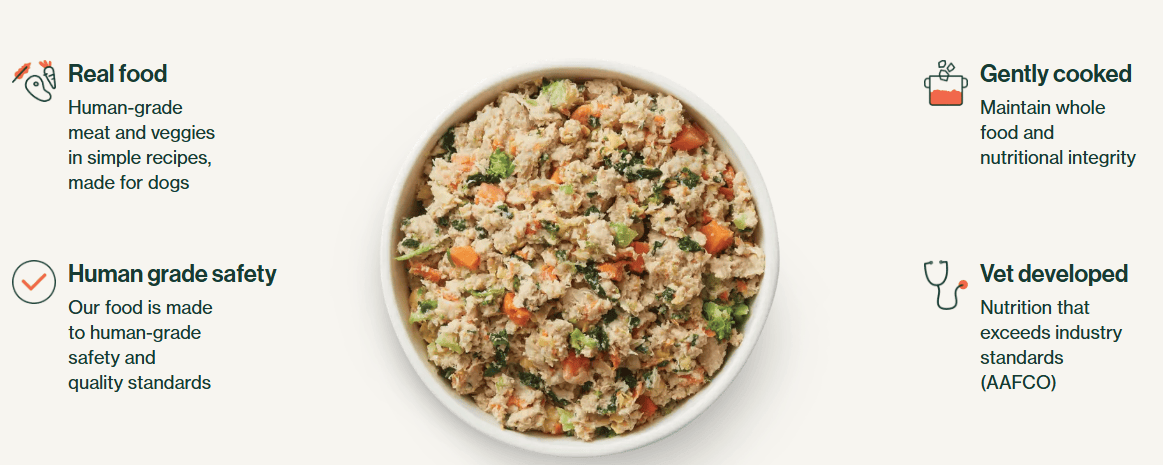
- Markets its food explicitly as human-grade: its homepage title is “Human-Grade Fresh Dog Food Delivery,” its meta description promises “100% human-grade food,” and its FAQ states “our food is made to human-grade safety and quality standards.” Its Instant Fresh line carries the same claim
- States both a formulation and a feeding-trial claim for AAFCO compliance. Its veterinary-facing portal says recipes are “Backed by AAFCO Feeding Trial & meets WSAVA guidelines,” designed by board-certified nutritionists and verified through multi-year feeding trials plus third-party palatability and digestibility research
- Its FAQ states that all recipes undergo strict quality and safety testing and do not contain the high levels of heavy metals reported in some kibble and air- or freeze-dried products. No third-party lab, testing lot, or certificate of analysis is published, so treat this as a qualitative claim rather than a number you can compare against other brands
- Plans are personalized through a short quiz asking for your dog’s zip code, sex, age, breed, current and target weight, activity level, pickiness, current food, treat amount, and health conditions
- Meals arrive individually pre-portioned by recipe. Running the quiz for a sample dog (a 17-year-old, 33-lb mixed breed) surfaced three pre-portioned recipes: Pork & Grain, Chicken & Grain, and Turkey (grain-free)
- Pricing is tiered by how much of the plan replaces your dog’s diet. For that sample dog, the site quoted Full portion (covers full daily calories) at $4.85/day, Half portion (meant to mix with other food) at $3.49/day, and Smallest portion (budget option) at $2.48/day, with a $2.42/day introductory rate on Full portion for a two-week starter box. These figures are specific to one dog’s profile, not a universal rate
- Direct-to-consumer only — none of the pages we checked mention Walmart, Amazon, Chewy or any other retailer
What to watch
- No published total recipe count: the quiz surfaces a subset matched to your dog’s profile rather than a single list
- Not stated: whether meals ship frozen or refrigerated, and what the day-to-day thaw and storage routine looks like. Pre-portioning is confirmed; storage temperature is not
- Not stated: a recommended transition schedule, or whether a multi-dog discount exists
- For this sample senior dog, the Full portion description included a claim that it’s “clinically shown to support healthy aging.” That’s the brand’s own marketing language; we haven’t independently verified the underlying claim, so read it as a brand claim rather than settled fact
- As with any subscription in this category, plan changes such as weight updates and recipe swaps happen through the account dashboard rather than automatically, so build in a reminder when your dog’s weight shifts
Where it fits: The Farmer’s Dog backs its AAFCO formulation with a stated feeding-trial claim, leans harder into the human-grade label than any other brand here, and ships individually pre-portioned recipes at a per-day price that scales with how much of the plan you use to replace your dog’s diet. For a sample senior, mixed-breed dog, that ran from roughly $2.48 to $4.85 a day before the introductory discount — run your own dog’s profile through the quiz, since pricing is personalized and that example won’t match your dog’s numbers.
Ollie
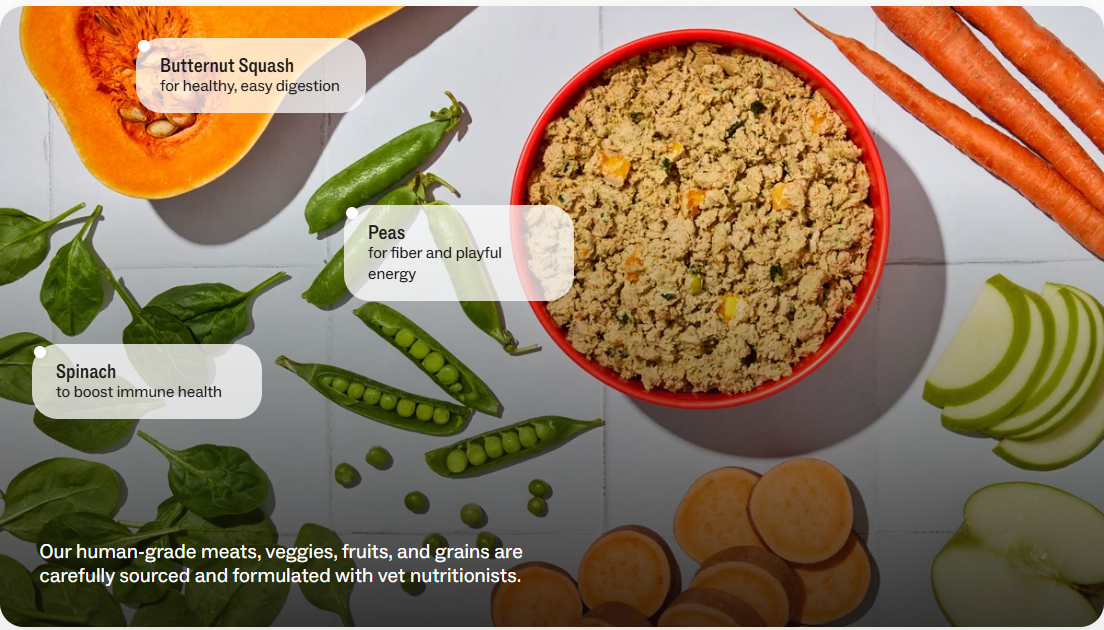
Ollie splits its lineup into two lines, Fresh and Baked, and backs both with an explicit human-grade manufacturing claim rather than just an ingredient-quality one.
What works
- Offers two distinct lines, Fresh and Baked, which gives you some flexibility on texture and storage
- Recipes are described as “Vet+Chef Developed” and “designed with veterinary nutritionists and food safety experts,” and the brand states “all of our recipes are formulated to meet AAFCO guidelines for all life stages”
- Unusually explicit about its human-grade manufacturing claim, saying its food is “cooked in licensed, human-grade facilities” that “meet or exceed all FDA and USDA standards for human-grade food manufacturing, including USDA Process Verified certification”
- Available through Petco in addition to direct subscription, useful as a backup source
- Recommends a 7-day transition: a small amount mixed in on days 1–2, 50% on days 3–4, 75% on days 5–6, and 100% on day 7, stretched to 10 days or more if you see loose stool
What to watch
- No published per-meal price range on the pages we checked; the homepage shows only a first-box promotion
- The direct subscription lists five fresh recipes (Beef, Chicken, Turkey, Lamb, Pork), but Petco stores carry four of them (Beef, Chicken, Turkey, Pork) plus two baked recipes, so the in-store selection is narrower than the online one
- Not stated on the pages we checked: storage instructions for the Fresh and Baked lines, a multi-dog discount, or recipes intended for dogs with diagnosed conditions
Where it fits: Owners who want a personalized plan but also like having a retail fallback if a subscription ever lapses.
Nom Nom
Nom Nom names a board-certified veterinary nutritionist directly on its own site, a credential that’s specific and checkable in a category full of vaguer wording, and backs that up with the widest retail footprint of the five services here.

What works
- Recipes are “formulated and scientifically evaluated for nutritional balance by board-certified veterinary nutritionists,” and its veterinary page states they are “formulated by a board-certified veterinary nutritionist”
- States its recipes “meet standards set by AAFCO’s Dog Food Nutrient Profiles for all life stages”
- Individually portioned per meal, reducing guesswork
- Sold through Chewy, PetSmart and Amazon in addition to direct subscription, which matters if you ever need a same-week backup
- One of the few brands here that confirms a multi-dog discount in its own FAQ: “we also provide cost savings for less frequent deliveries and offer a multi-dog discount”
- Published per-meal bands run “$1.60 – $2.60/Meal” for dogs 5–25 lbs, “$2.61 – $3.60/Meal” for 26–45 lbs, and “$3.61 – $4.60/Meal” for dogs over 45 lbs
- No prescription diets, and says so plainly: “we don’t currently offer prescription diets for dogs”
What to watch
- Frozen format requires freezer space and thaw time
- Six recipes on the subscription (Turkey Fare, Beef Mash, Chicken Cuisine, Pork Potluck, Lamb Pilaf, Turkey & Chicken Cookout), a mid-sized lineup for this category
- Says it “backs up all of our products with feeding studies,” but describes them as palatability and digestibility studies — an internal testing program, not an AAFCO feeding trial
- Not stated on the pages we checked: a transition timeline in days, or a formal human-grade claim
- Best suited to owners comfortable managing a subscription cadence rather than grabbing a bag on a whim
Where it fits: Owners who want the most explicit vet-nutritionist formulation story of the five services here, and who value having retail availability as a backup.
Spot & Tango (UnKibble)
Spot & Tango’s UnKibble is the brand’s own “Fresh Dry™” format: gently dried rather than frozen, so it sits in the pantry instead of taking up appliance space.

What works
- Shelf-stable “Fresh Dry™” format, so there’s no freezer or fridge commitment
- Noticeably easier to travel with, or to store in a small kitchen, than any frozen or refrigerated option here
- States “all of our recipes meet or exceed the AAFCO Nutrient Profiles for all life stages, including growth of large size dogs (>70 pounds or more as an adult),” so puppies are covered, though growing puppies may need portion adjustments
- Recommends “a slow 7-10 day transition to avoid an upset stomach when switching diets”
- Pricing is published, if only as a floor: “UnKibble meal plans start at $1/day, Fresh meal plans start at $2/day, and all plans include free shipping”
What to watch
- UnKibble currently lists three recipes: Beef + Barley, Turkey + Sweet Potato, and Cod + Salmon — a narrow lineup if your dog needs protein rotation
- Also sells a separate frozen “Fresh” product line alongside UnKibble, so check which product your cart actually contains. The Fresh line’s current recipe names and count aren’t listed on the pages we checked
- Direct-to-consumer only, and the shipping footprint is narrower than it looks: it ships “to verified addresses in the forty-eight contiguous US states,” which rules out Alaska, Hawaii and Canada
- Not stated on the pages we checked: a multi-dog discount, or recipes intended for dogs with diagnosed conditions
- Shelf-stable formats trade some of the raw-adjacent texture of frozen fresh food for convenience — not the pick if your dog specifically likes a wetter texture
Where it fits: Owners with limited freezer or fridge space, frequent travelers, and anyone who wants fresh-food ingredients without a permanent appliance commitment.
Sundays for Dogs
Sundays is air-dried rather than frozen or fresh-dried, which gives it a texture closer to a dense kibble than anything else in this lineup — useful if your dog is coming off kibble and you want the smallest possible jump.

What works
- Air-dried format is shelf-stable and has a texture closer to a dense kibble, described by the brand as “gently air-dried at low temperatures to preserve nutrients and taste – no high heat, no freezing”
- Founded by a veterinarian, and the brand foregrounds it: “Vet founded. Vet operated. Vet formulated.” Its own materials identify Dr. Tory Waxman as co-founder and Chief Veterinary Officer, with an animal sciences degree from Cornell and a veterinary degree from the University of Pennsylvania
- Beyond the founder, the company says it employs “a veterinarian nutritionist (boarded with the ACVN) and an animal nutritionist PhD part-time” who “formulate and review all of our recipes”
- Prints the full AAFCO statement on each recipe page, and confirms this is by formulation, not feeding trials
- Puppies are covered from the start: “all of our recipes are formulated for all life stages, including growth of large-size dogs, so puppies can eat Sundays from the start”
- Publishes a clear 10-day transition schedule: 25% on days 1–3, 50% on days 4–6, 75% on days 7–9, and 100% from day 10
- No thawing, no fridge, no prep beyond scooping
What to watch
- Four core recipes: Beef, Chicken, Turkey and Fish — a mid-sized lineup here, larger than UnKibble’s three but well short of Nom Nom’s six
- No published per-day or per-meal pricing. Sundays declines to publish figures, saying only that “the cost of your Sundays plan depends on your dog’s profile and how much food they need.” The one hard number on its own site is that “subscribers automatically receive a 20% discount on every recurring order”
- Air-drying is a different process from fresh-frozen or fresh-refrigerated — not the pick if your dog specifically wants a wetter, more raw-adjacent texture
- Not a substitute for a prescription diet: “if your veterinarian has prescribed a prescription diet, follow your vet’s guidance. Sundays is not intended to replace a prescription food”
- Lists no retail partners; ships to all 50 states including Alaska and Hawaii, but not to Canada “due to the strict regulation of cross-border meat products”
- Not stated: whether Sundays offers a multi-dog discount
Where it fits: Owners of picky or texture-sensitive eaters coming off kibble, and anyone who wants the least day-to-day prep of the five services here.
Which One Fits Your Situation
You want a hands-off, pre-portioned routine and care about human-grade and feeding-trial claims
The Farmer’s Dog confirmed on the points that matter most here: meals arrive individually pre-portioned by recipe, and its own quiz returned real per-day pricing for a sample dog (roughly $2.48–$4.85/day before the introductory discount, scaled to portion size). What we still don’t know is whether it ships frozen or refrigerated — check that detail yourself before you commit, since it changes how much kitchen space you’ll need to give up.
You don’t have freezer space, or you travel often with your dog
Spot & Tango’s UnKibble and Sundays for Dogs both remove the storage commitment entirely. Pick between them based on whether your dog does better with a fresh-dried or an air-dried texture.
Your dog is picky and currently eating only kibble
Try a shelf-stable, dry-adjacent format such as Sundays for Dogs or Spot & Tango’s UnKibble before you try a wetter, frozen one. A smaller jump in texture gives you a better shot at an easy transition.
Your dog has itching, ear trouble or a reactive stomach
Talk to your vet first, because none of these five is a prescription or elimination diet. If you’re avoiding one known protein rather than hunting for the culprit, count recipes before you subscribe: Nom Nom lists six, Ollie five, Sundays four, and Spot & Tango’s UnKibble three.
You want the most explicit vet-nutritionist formulation story
Nom Nom and Sundays are the two that name the credential directly. Nom Nom says its recipes are formulated by a board-certified veterinary nutritionist, and Sundays says an ACVN-boarded veterinary nutritionist and an animal nutrition PhD formulate and review all of its recipes.
You want a subscription with a retail backup in case shipping is delayed
Nom Nom (Chewy, PetSmart, Amazon) and Ollie (Petco) both give you a same-week fallback that a direct-only subscription doesn’t. Spot & Tango and Sundays are direct-only.
You’re managing multiple dogs of different sizes
Run each dog’s profile through the brand’s own calculator separately. Per-dog cost scales with weight and activity level, so a good deal for a 15-pound dog isn’t necessarily a good deal for a 70-pound one. Of the five, only Nom Nom confirms a multi-dog discount on its own site; The Farmer’s Dog, Ollie, Spot & Tango and Sundays don’t address it on the pages we checked.
Your dog has a diagnosed health condition or is a puppy: bring your vet in before you switch, whichever brand you’re considering, and ask specifically whether the recipe in front of you suits that life stage or condition. Homepage marketing copy is not a substitute for that conversation.
Common Questions
Is fresh dog food better than kibble, or is that marketing?
“Better” depends on what you’re optimizing for. Fresh food generally means shorter ingredient lists and less processing than extruded kibble. But kibble that’s formulated to AAFCO standards and matched to your dog’s life stage isn’t inherently unsafe, and plenty of dogs do well on it for years. The honest answer is that fresh food is a legitimate option worth considering, not a requirement every dog needs.
Will a fresh food subscription fix my dog’s food allergy?
It won’t diagnose one, and no service here claims it will. Identifying a food allergy takes a vet-directed elimination trial, typically running a single hydrolyzed or genuinely novel protein for weeks before anything is reintroduced. What a subscription can do is give you a short, legible ingredient list so you can see exactly what your dog is eating and change one variable at a time. Two of the five state their limits plainly: Nom Nom says it doesn’t “currently offer prescription diets for dogs,” and Sundays says it “is not intended to replace a prescription food.”
Do I need to transition my dog slowly onto fresh food?
Generally yes. Most brands recommend a gradual switch over a week or more to avoid digestive upset, and several publish their own schedules. Ollie recommends 7 days (a small amount mixed in on days 1–2, then 50%, then 75%, then 100% on day 7), and says to stretch it to 10 days or more if you see loose stool. Spot & Tango recommends “a slow 7-10 day transition.” Sundays publishes a 10-day version: 25% for days 1–3, 50% for days 4–6, 75% for days 7–9, then 100% from day 10. Nom Nom says your first box is structured to help with the switch and comes with customized feeding instructions, but doesn’t publish a day count. The Farmer’s Dog doesn’t state a timeline on the pages we checked.
Can I mix fresh food with kibble to save money?
Many owners do exactly this, using fresh food as a partial meal or a topper rather than a full replacement. If you go that route, check with your vet that the combined portions still add up to appropriate daily calories for your dog’s weight. Overfeeding is easy when portions from two different systems overlap, and each system assumes it’s the whole meal.
Is fresh dog food safe for puppies or dogs with health conditions?
Those are two different questions with different answers. On puppies, four of the five state all life stages on their own sites (Ollie, Nom Nom, Spot & Tango and Sundays), with Spot & Tango and Sundays specifically including growth of large-breed dogs of 70 lb or more as adults. Sundays puts it directly: puppies “can eat Sundays from the start.” The Farmer’s Dog markets puppy, adult and senior plans and calls its recipes AAFCO complete and balanced, but its exact AAFCO life-stage statement isn’t shown on its public pages. On medical conditions, none of these is marketed as a prescription diet. Nom Nom states it doesn’t “currently offer prescription diets for dogs,” and Sundays says it “is not intended to replace a prescription food.” Confirm with the brand and your own vet before feeding a growing or medically managed dog exclusively on any of these. The Farmer’s Dog, Ollie and Spot & Tango don’t address prescription-diet needs on the pages we checked.
Start with your kitchen, not the price
There’s no single best fresh dog food subscription. There’s a best fit for how your kitchen works, how your dog eats, and how much day-to-day effort you’re willing to put in. So before you compare a single price, answer two questions. Does the storage format fit your kitchen and your travel habits? And does your dog’s eating history suggest they’ll take to a wetter, frozen texture, or do better easing in with something shelf-stable and drier?
Get those two right and most of the five services above become a reasonable choice. Get them wrong and even the most nutritionally sound plan ends up sitting untouched in the fridge.
One closing note on the state of this guide: The Farmer’s Dog publishes little outside its signup flow, so we confirmed its human-grade, AAFCO, retail and pricing claims from its public pages and a sample run through its own quiz. What’s left for that brand is mainly whether it ships frozen or refrigerated, its total recipe catalog, and its transition and multi-dog policies. A handful of pricing and storage figures for the other four brands aren’t stated on their sites either. We’d rather show you those gaps than paper over them with numbers we couldn’t confirm. We’ll update this page when the brands publish them.
See our top pick: Nom NomAbout the authors: petloverofficial.com is run by two co-editors, Shiori and Daisuke. Every guide is built from the brands’ own product pages, help centers and published statements, and neither of us publishes one until the other has checked the numbers against the source. More about us.
Related guides:
- Senior Dog Food Labels: What “Complete and Balanced” Actually Promises Your Older Dog — question 2 above, applied to the bag on a shelf: “senior” is not an AAFCO life stage, and the sentence that is sits in small type on the back.
- Does Pet Insurance Cover Pre-Existing Conditions? — worth reading if you came here because of itching, ear trouble or a reactive stomach. Allergies appear on the incurable lists Embrace and Pets Best publish, so an allergy already in your dog’s records when you buy a policy stays excluded for life.


Leave a Reply